



What's Happening?
Oracle Corporation's 5-year credit default swaps (CDS) have widened to a record 356 basis points (bps), or 3.56%, marking a significant increase from 154 bps at the end of 2025 and 35-45 bps in mid-2025. This figure is approximately 75% to 80% above its
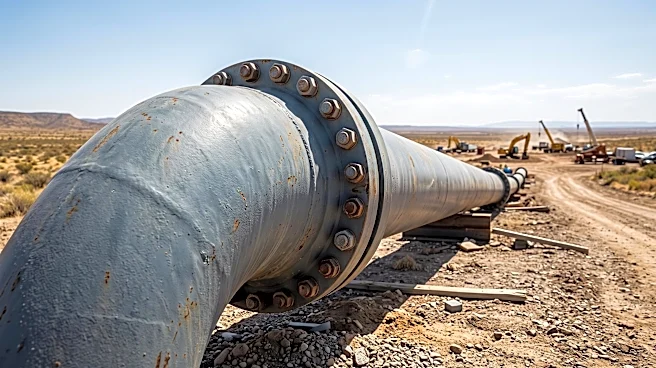
2008 financial crisis peak. This surge in CDS spreads, which indicate market concern about a company's ability to repay its lenders, is partly attributed to issues with 'Project Jupiter,' Oracle's data center campus in Santa Teresa, New Mexico. Oracle issued a force majeure notice to Stack Infrastructure, owned by Blue Owl Capital, due to power delays, potentially pushing back rent commencement by up to three years. The natural gas pipeline for the site is unfinished, and the final state air-quality permit for the fuel-cell microgrid is delayed until 2027. Additionally, Oracle faces heavy cash burn and a substantial reliance on OpenAI, which accounts for roughly half of Oracle's $664 billion backlog, with OpenAI reportedly owing Oracle about $60 billion annually under a five-year, $300 billion contract.
Why It's Important?
The record-high credit default swaps for Oracle signal a growing concern among investors regarding the company's financial stability and its ability to meet its debt obligations. This could lead to increased borrowing costs for Oracle, potentially impacting its future investment and expansion plans. The delays in 'Project Jupiter' highlight significant operational risks, particularly in critical infrastructure projects, and could result in substantial financial penalties or lost revenue from delayed data center operations. Furthermore, Oracle's heavy reliance on OpenAI, a company that recently reported a quarterly loss exceeding its revenue, introduces considerable counterparty risk. If OpenAI faces financial difficulties, Oracle's substantial backlog and revenue streams could be jeopardized, affecting its overall financial health and market valuation. This situation could also influence how other technology companies structure their partnerships and manage large-scale infrastructure projects, especially those with significant energy requirements and regulatory hurdles.
What's Next?
Oracle's immediate future will likely involve addressing the power supply issues at its 'Project Jupiter' data center in New Mexico to mitigate further delays and financial repercussions. The company will need to navigate the complexities of securing the natural gas pipeline and obtaining the necessary air-quality permits, which are currently projected for 2027. The market will closely monitor OpenAI's financial performance and its ability to meet its contractual obligations to Oracle, given its recent reported losses. Any further financial strain on OpenAI could directly impact Oracle's revenue and backlog. Additionally, the political landscape in New Mexico, with Governor Deb Haaland's stance on pausing new large-scale data center projects, could introduce further regulatory challenges for Oracle and similar companies. The widening CDS spreads suggest that bond and CDS markets will continue to price in these risks, potentially leading to ongoing volatility in Oracle's stock and bond performance.
Beyond the Headlines
The situation with Oracle's credit default swaps and project delays points to broader systemic risks within the technology and infrastructure sectors, particularly concerning the rapid expansion of data centers and their energy demands. The reliance on a single major client like OpenAI, especially one with reported financial instability, underscores the inherent risks in highly concentrated business relationships within the tech industry. This scenario could prompt a re-evaluation of risk management strategies for large-scale infrastructure projects, particularly those dependent on complex energy solutions and subject to evolving environmental regulations. The political intervention in New Mexico regarding data center projects also highlights the increasing scrutiny and potential regulatory hurdles that tech companies may face as they expand, particularly concerning environmental impact and resource consumption. This could lead to a shift towards more decentralized or environmentally sustainable data center development models, or increased pressure on companies to demonstrate robust environmental compliance and energy independence.