







What's Happening?
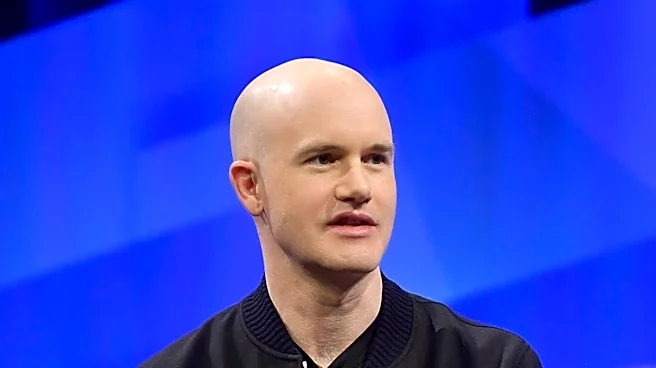
Coinbase CEO Brian Armstrong has sparked controversy by stating that he views philanthropy as a "net negative on the world." During an appearance on the Katie Miller Podcast, Armstrong argued that many charities and philanthropies become "captured by ideology,"
making them ineffective or even detrimental. He contrasted his view with the traditional perception of philanthropy as a noble cause, citing historical figures like Andrew Carnegie and John D. Rockefeller who engaged in charitable acts. Despite his estimated net worth of around $8.7 billion, Armstrong indicated that he has no plans to engage in traditional philanthropic endeavors, stating, "so far, I’ve just been like ‘I’m not going to do that.’"
Why It's Important?
Armstrong's comments are significant as they challenge conventional notions of corporate social responsibility and the role of wealthy individuals in society. His stance could influence how other tech billionaires and entrepreneurs approach wealth distribution and social impact, potentially leading to a reevaluation of philanthropic models. In the U.S., where philanthropy plays a substantial role in funding social services, research, and cultural institutions, a shift in this mindset could have far-reaching consequences for non-profit organizations and the communities they serve. The debate over the effectiveness and ideological capture of charities is not new, but Armstrong's prominent position and wealth bring renewed attention to these criticisms, potentially fostering discussions about alternative approaches to social good or direct investment in solutions rather than traditional charity.
What's Next?
Armstrong's controversial remarks are likely to continue generating discussion and debate within the tech and philanthropic communities. It remains to be seen whether his views will gain traction among other wealthy individuals or if they will be largely dismissed. This could lead to increased scrutiny of existing philanthropic organizations and their operational transparency. It may also encourage new models of social impact investment or direct action initiatives that bypass traditional charitable structures. For Armstrong and Coinbase, these comments could shape public perception and potentially influence their brand image, particularly among stakeholders who value corporate social responsibility. The broader conversation about the most effective ways to address societal challenges and the role of private wealth in those efforts is expected to evolve.
Beyond the Headlines
Armstrong's critique of philanthropy delves into deeper philosophical questions about the efficacy of large-scale charitable giving and the potential for ideological influence to distort original intentions. His comments reflect a growing skepticism among some in the tech industry regarding traditional institutions and a preference for more direct, often technology-driven, solutions to societal problems. This perspective could signal a long-term shift in how wealth is deployed for social good, moving away from traditional endowments and towards more agile, outcome-oriented investments. It also highlights the tension between individual autonomy in wealth management and societal expectations for philanthropic contributions from the ultra-rich. The discussion could also prompt a re-examination of the tax incentives and regulatory frameworks surrounding charitable giving in the U.S., potentially leading to reforms aimed at ensuring greater accountability and impact.