








What's Happening?
Dronamics Group Limited, a developer and operator of long-range unmanned aircraft systems, has announced a definitive business combination agreement with GP-Act III Acquisition Corp. (Nasdaq: GPAT), a special purpose acquisition company. This transaction
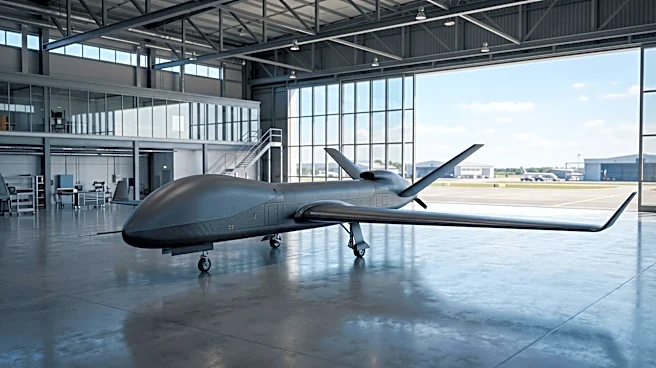
is expected to result in Dronamics being listed on Nasdaq. The deal values Dronamics at a pre-money equity value of $400 million, with an implied pro-forma enterprise value of approximately $500 million. Existing Dronamics shareholders are slated to roll over 100% of their equity into the combined entity. The proposed transaction aims to secure approximately $100 million in net cash proceeds for Dronamics, derived from PIPE financing and GPAT’s trust account, subject to shareholder redemptions and PIPE commitments. The funds are intended to scale the production of Dronamics’ Black Swan aircraft, accelerate commercial operations, and support growth in autonomous logistics, national security, critical minerals exploration, and sovereign aerospace. The transaction has been approved by both boards and is anticipated to close in the first half of 2027, pending shareholder and regulatory approvals.
Why It's Important?
This Nasdaq listing marks a significant step for Dronamics, enabling it to access U.S. capital markets for expansion. The infusion of approximately $100 million in net cash proceeds will be crucial for scaling the production of its Black Swan aircraft, which is designed for diverse applications including cargo logistics, military resupply, intelligence, surveillance, and reconnaissance (ISR). This development could significantly impact the autonomous aviation sector by introducing a new player with long-range, high-payload drone capabilities. For the U.S. market, Dronamics' plans to launch operations in the country could enhance logistics efficiency, particularly in middle-mile cargo delivery, and bolster national security capabilities through advanced unmanned aerial systems. The company's strategic partnerships, including with Hellmann Worldwide Logistics and HENSOLDT, suggest a strong commercialization pathway and potential for widespread adoption, creating new opportunities and competition within the logistics and defense industries.
What's Next?
The next steps involve securing approval from GPAT’s shareholders and obtaining necessary regulatory clearances for the business combination. The transaction is projected to close in the first half of 2027. Following the listing on Nasdaq, Dronamics plans to utilize the proceeds to ramp up manufacturing of its Black Swan aircraft and expand its commercial operations, including launching services in the U.S. The company will also focus on integrating its Black Swan platform into various sectors, such as cargo logistics, national security, and critical minerals exploration. Further announcements regarding PIPE financing commitments and detailed operational plans for the U.S. market are expected as the closing date approaches. The success of this public listing will likely influence investor confidence in the autonomous aviation sector and could pave the way for other drone technology companies seeking similar growth opportunities.
Beyond the Headlines
The public listing of Dronamics highlights a broader trend of increasing investment and interest in autonomous aviation technologies, particularly for cargo and defense applications. The Black Swan's multi-mission capabilities, spanning commercial logistics to military uses like airborne early warning and counter-UAS, underscore the dual-use nature of advanced drone technology. This development could accelerate the integration of unmanned aircraft into critical infrastructure and defense strategies, potentially reshaping supply chains and national security paradigms. Ethical and regulatory frameworks surrounding autonomous flight, airspace management, and data security will become increasingly important as such technologies become more prevalent. The success of Dronamics could also spur further innovation in drone design, propulsion systems, and operational models, pushing the boundaries of what is possible in autonomous aerial transport and surveillance.