





What's Happening?
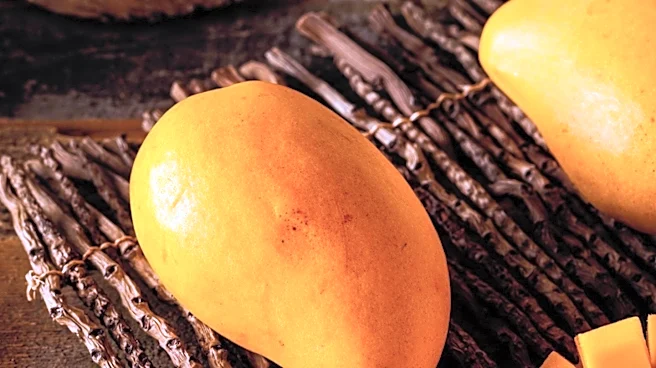
Two Ugandan students, Sandra Namboozo and Samuel Muyita, have developed an innovative, biodegradable sachet called Karpolax that significantly extends the shelf life of mangoes. This natural sachet, made from plant extracts like cloves, lemongrass, eucalyptus,
and wintergreen, slows ripening and prevents spoilage. In pilot tests conducted with Uganda's National Agricultural Research Organisation, Karpolax increased mango shelf life from 11 days to 33 days without refrigeration. The invention, which also proved effective on bananas, apples, and oranges, addresses a critical issue of post-harvest losses faced by smallholder farmers. Namboozo and Muyita, who grew up in farming families and witnessed their parents' struggles with spoilage, launched Karpolax in 2020. Their work earned them the Community Healers Prize at the European Patent Office's Young Inventors Prize in Reykjavik in 2025, along with a €20,000 award, selected from over 450 global candidates.
Why It's Important?
This innovation holds significant importance for food security and economic stability, particularly in regions heavily reliant on agriculture. For smallholder farmers, the ability to triple the shelf life of produce like mangoes means a substantial reduction in waste and a direct increase in income. This low-tech, affordable solution bypasses the need for expensive refrigeration, making it accessible to farmers in developing countries who often lack such infrastructure. The success of Karpolax demonstrates the potential for local, plant-based solutions to address global challenges, offering a model for sustainable agriculture and entrepreneurship. It highlights how practical, community-rooted inventions can have a profound impact on livelihoods and food supply chains, fostering economic resilience and reducing food loss from farm to market.
What's Next?
While pilot tests have shown promising results, independent large-scale verification of Karpolax's effectiveness is still pending. The next steps will likely involve broader testing and scaling up production to make the sachets widely available to farmers. The €20,000 prize money could be instrumental in funding further research, development, and distribution efforts. The recognition from the European Patent Office may also attract additional investment and partnerships, potentially leading to wider adoption across Africa and other regions facing similar post-harvest challenges. The inventors may also explore expanding the application of Karpolax to a wider variety of fruits and vegetables, further enhancing its impact on food preservation and agricultural sustainability.
Beyond the Headlines
The story of Karpolax transcends a simple product innovation; it underscores the power of lived experience in driving impactful solutions. Born from the direct observation of family struggles, this invention challenges conventional notions that food preservation requires high-tech, expensive infrastructure. It highlights a shift towards valuing indigenous knowledge and natural resources in addressing complex problems. This development could inspire a new wave of 'appropriate technology' – solutions that are tailored to local conditions and resources, fostering self-reliance and sustainable development. It also raises ethical considerations about intellectual property and ensuring that such innovations remain accessible and beneficial to the communities they are intended to serve, rather than being monopolized by larger corporations.