








What's Happening?
Lockheed Martin's Skunk Works advanced development division is significantly increasing its investment in the Vectis stealth drone program. The company announced plans to build an additional four prototypes, bringing the total to five, including the one currently
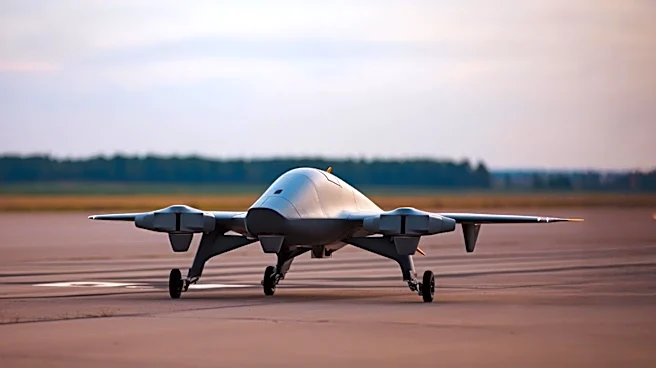
under production. This expansion aims to accelerate testing and validate production processes for the advanced unmanned aircraft. Ron Fehlen, who leads Skunk Works, stated that development work on these new prototypes is already underway, with a goal to build and fly them even more quickly than the initial prototype, which is slated for its first flight by the end of 2027. The Vectis drone is designed as a large 'Group 5' stealth drone, emphasizing flexibility for various missions such as air-to-air, air-to-ground, and intelligence, surveillance, and reconnaissance (ISR), with customizable payloads and mission systems. Lockheed Martin is showcasing a full-scale model of the Vectis at the Association of the Air and Space Force conference, revealing new technical specifications. The tailless aircraft measures approximately 34 feet long with a wingspan of about 38 feet, comparable in length to an MQ-9 Reaper and with a wingspan similar to an F-35. A key design feature highlighted is its submerged inlet on the top of the aircraft, intended to reduce drag and prevent foreign object debris (FOD) ingestion, which is beneficial for operations in austere environments.
Why It's Important?
This increased investment by Lockheed Martin in the Vectis stealth drone program underscores a strategic shift towards advanced autonomous combat capabilities within the U.S. defense industry. The development of additional prototypes signals a commitment to rapidly mature this technology, which could significantly impact future aerial warfare strategies. The Vectis, designed for multi-mission flexibility and survivability, aims to integrate with crewed aircraft like the F-35, extending their reach and creating new tactical options. This could enhance the operational effectiveness of the U.S. Air Force and its allies, providing a critical edge in contested environments. The focus on affordability, with a target unit cost competitive with Collaborative Combat Aircraft (CCA) programs, suggests a broader effort to make advanced drone technology more accessible for large-scale deployment. The emphasis on digital design and advanced manufacturing processes, which have reportedly reduced labor hours by 80%, could set new industry standards for efficiency and cost-effectiveness in defense production. This could lead to faster development cycles and more rapid fielding of advanced military hardware, benefiting the U.S. defense industrial base and potentially influencing global defense markets.
What's Next?
The immediate next steps for Lockheed Martin involve the continued development and construction of the additional four Vectis prototypes, with an accelerated timeline for their first flights. The initial prototype is still on track for its maiden flight by the end of 2027. The company will likely continue to refine the drone's design and capabilities based on testing data from these prototypes. Lockheed Martin is also expected to engage with potential domestic and international customers to tailor the Vectis for specific operational requirements, particularly for Collaborative Combat Aircraft (CCA) initiatives. The ongoing showcase of the full-scale model at industry conferences suggests a continued effort to generate interest and secure future contracts. Further details on the drone's performance specifications, engine type, and specific integration plans with existing crewed aircraft are anticipated as the program progresses. The success of the Vectis program could influence future U.S. military procurement decisions regarding autonomous systems and potentially lead to broader adoption of similar advanced manufacturing techniques across the defense sector.
Beyond the Headlines
The accelerated development of the Vectis stealth drone highlights a deeper trend in military aviation: the increasing reliance on autonomous, AI-driven systems to augment and eventually transform traditional air combat. The drone's design, particularly its emphasis on survivability and multi-mission capability, reflects a strategic response to evolving threats and the need for adaptable platforms in complex operational environments. The integration of Vectis with crewed aircraft like the F-35 points to a future where human-machine teaming becomes central to military strategy, raising ethical and operational questions about the division of labor and decision-making authority between human pilots and AI. The use of advanced digital engineering and manufacturing processes, which significantly reduce production time and cost, could democratize access to high-end military technology, potentially altering the balance of power in global defense. This shift towards more affordable and rapidly deployable autonomous systems could also trigger a new arms race in drone technology, compelling other nations to invest heavily in similar capabilities to maintain parity or gain a strategic advantage. The long-term implications include a redefinition of air superiority, changes in military doctrine, and potential shifts in the global defense industrial landscape.