



What's Happening?
Ross Douthat has proposed a personal test for AI superintelligence, suggesting that an AI model could be declared comprehensively superhuman if its capacities were such that it would make more sense for a company's board to replace its human CEO with
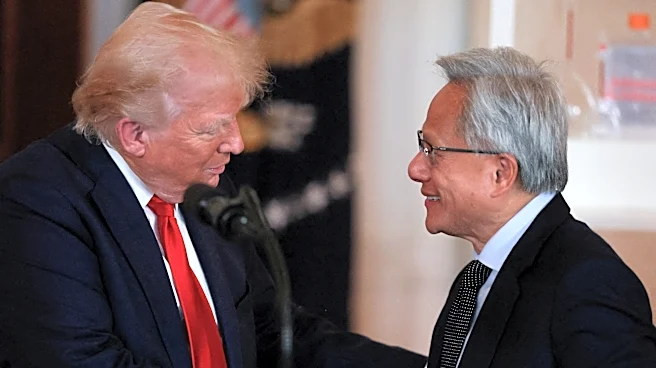
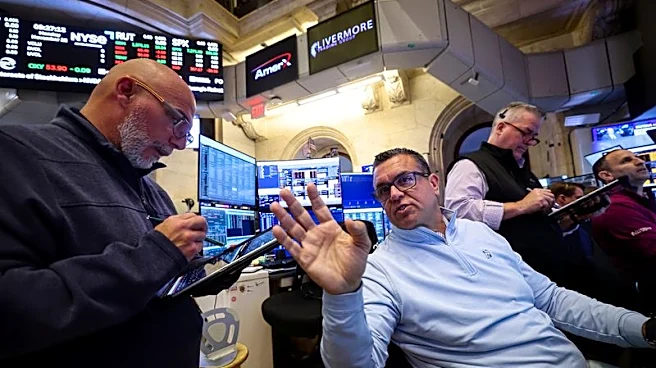
an AI CEO. Douthat uses the recent return of Jensen Huang to Nvidia as a benchmark, noting the significant positive market reaction to Huang's leadership compared to the more subdued reaction to Anthropic's AI capabilities in mathematics. He observes that while Anthropic's Claude demonstrated the ability to solve complex mathematical problems, the stock market's response to Huang's return indicated a greater valuation of human leadership and its broader impact on the tech sector. Douthat posits that the true test for AI superintelligence lies in its ability to extend beyond computable areas to encompass the less quantifiable aspects of human competition and leadership.
Why It's Important?
Douthat's proposed test highlights a critical distinction in the ongoing debate about AI's capabilities and its potential to surpass human intelligence. It shifts the focus from purely technical or computational prowess to the broader, more complex domains of leadership, strategic decision-making, and market influence. For U.S. businesses and the economy, this perspective suggests that while AI can excel in specific tasks, its ability to navigate the multifaceted challenges of corporate leadership, which involve human intuition, negotiation, and vision, remains a significant hurdle. The market's reaction to Huang's return underscores the current irreplaceable value placed on human leadership in driving innovation and economic growth. This implies that the economic impact of AI will likely be more about augmentation rather than outright replacement of high-level human roles in the near future, influencing investment strategies and workforce development in the U.S.
What's Next?
The discussion around Douthat's test will likely contribute to ongoing conversations among AI researchers, ethicists, and business leaders about the benchmarks for true superintelligence. As AI models continue to advance, future developments may increasingly attempt to address the 'less computable areas of human competition' that Douthat references. This could lead to new research directions focused on AI's ability to handle ambiguity, exercise judgment, and demonstrate creativity in complex, real-world scenarios. The financial markets will continue to serve as a real-time barometer, reacting to both AI breakthroughs and human leadership decisions, providing further data points for evaluating AI's perceived value. Companies may also begin to explore hybrid leadership models, where AI assists human executives in strategic decision-making, rather than outright replacing them, as a step towards integrating advanced AI into corporate governance.
Beyond the Headlines
Douthat's test delves into the philosophical implications of AI superintelligence, particularly concerning human agency and the definition of leadership. It implicitly questions whether intelligence can be fully quantified or if there are inherent human qualities that AI cannot replicate, especially in roles requiring nuanced understanding of human behavior and societal dynamics. The comparison between AI's mathematical prowess and a CEO's market impact also touches upon the societal valuation of different forms of intelligence. This could lead to deeper discussions about the ethical boundaries of AI development, the potential for AI to reshape societal power structures, and the long-term implications for human employment and purpose. The idea of an AI CEO also raises legal and ethical questions about accountability, responsibility, and the nature of corporate personhood in an increasingly AI-driven world.