




What's Happening?
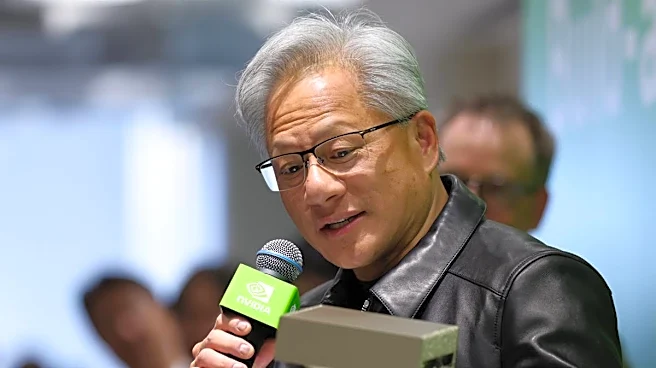
Nvidia CEO Jensen Huang is championing artificial intelligence as a key driver for reshoring manufacturing to the United States, describing the construction of 'AI factories' as the largest domestic industrial buildout in a generation. Nvidia has committed
to procuring hundreds of billions of dollars in U.S.-manufactured electronics over the next four years. This initiative includes domestic production of critical AI systems, such as Nvidia’s Blackwell and Grace Blackwell architectures, with TSMC handling fabrication and Foxconn and Wistron expanding their U.S. operations for assembly. A central component of this push is a $2 billion partnership with Coherent to expand a facility in Sherman, Texas, which will produce indium phosphide lasers essential for chip interconnects. This project is expected to create approximately 1,000 jobs, with about 550 in advanced manufacturing, engineering, and technical roles.
Why It's Important?
This strategic move by Nvidia, a leading AI company, has significant implications for U.S. manufacturing and job creation. By committing substantial investments to domestic production and leveraging AI as a reshoring catalyst, Nvidia is directly contributing to the revitalization of the U.S. industrial base. The initiative is bolstered by financial incentives from the CHIPS Act, which encourages domestic semiconductor and advanced manufacturing investments. Huang estimates that AI infrastructure initiatives have already generated around 500,000 jobs across various sectors, including construction, skilled trades, energy, and advanced manufacturing. This effort aims to reduce reliance on overseas supply chains, enhance national security through domestic control of critical technology production, and foster a new wave of high-tech employment within the United States. The projected third-party investments exceeding $500 billion underscore the cascading economic impact across the supply chain.
What's Next?
Nvidia's broader ambition includes establishing multi-gigawatt AI factory capacity, starting with an initial 4.25 GW in Ohio. This will require massive investments in power generation and grid infrastructure, which Huang characterizes as 'market-based investments in energy infrastructure.' The success of these initiatives will depend on continued government support, effective collaboration with partners like TSMC, Foxconn, and Wistron, and the ability to attract and train a skilled workforce. The focus will be on whether these investments translate into sustained job growth, increased domestic production capabilities, and a more resilient U.S. technology supply chain. The development of these AI factories will also serve as a test case for how AI can drive large-scale industrial transformation and economic development in the U.S.
Beyond the Headlines
The emphasis on domestic production of AI components and systems raises important questions about technological sovereignty and national competitiveness. By bringing advanced manufacturing back to the U.S., Nvidia is not only creating jobs but also strengthening the country's position in the global AI race. This reshoring effort could inspire other technology companies to follow suit, leading to a broader trend of domestic investment in critical sectors. The significant energy requirements for these AI factories also highlight the growing intersection of AI development and energy infrastructure, potentially accelerating innovation in sustainable energy solutions and grid modernization. This initiative could reshape the landscape of U.S. industrial policy, demonstrating how strategic investments in emerging technologies can drive both economic growth and national security objectives.