


What's Happening?
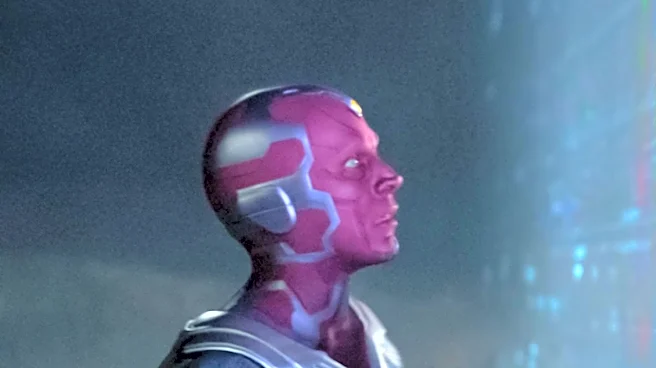
Paul Bettany, known for his role as Vision in the Marvel Cinematic Universe, has discussed his journey with the character, particularly in the new series 'VisionQuest.' Bettany initially joined Marvel as the voice of J.A.R.V.I.S. in 2008 before transitioning
to the physical role of Vision in 'Avengers: Age of Ultron.' He described the physical demands of the role, including an eight-hour makeup application that initially limited his shooting time to two hours a day, and the heavy, hot costume that required constant physical exertion. Despite these challenges, Bettany expressed his appreciation for the role, noting that he realized Vision resonates with audiences who feel like outsiders or have been bullied. He sees Vision as a character constantly discovering his identity and purpose, which he believes connects with young people undergoing similar self-discovery. In 'VisionQuest,' Bettany portrays White Vision, a version of the character who has regained his memories but struggles to attach emotions to them, leading to an identity crisis.
Why It's Important?
Bettany's insights into Vision's character arc and his connection with fans highlight the deeper thematic elements often explored within the Marvel Cinematic Universe. His realization that Vision serves as a relatable figure for those who feel marginalized underscores the franchise's ability to tackle complex emotional and social themes beneath its superhero facade. The physical demands Bettany describes also shed light on the often-unseen challenges actors face in blockbuster productions, emphasizing the dedication required for such roles. Furthermore, his involvement as an executive producer on 'VisionQuest' signifies a growing trend of actors taking on more creative control, influencing character development and narrative direction. This deeper engagement can lead to more nuanced and personal portrayals, enriching the storytelling for a global audience and potentially influencing how studios collaborate with their talent.
What's Next?
The conclusion of 'VisionQuest' leaves open the possibility of Vision's future in the Marvel Cinematic Universe. Bettany has indicated his willingness to continue playing the character as long as there are interesting stories to tell, suggesting that Vision's journey of self-discovery and emotional integration may evolve further. The exploration of White Vision's identity crisis could lead to new narrative directions, potentially involving other characters or storylines within the broader MCU. The collaborative approach taken with Bettany as an executive producer might also set a precedent for how Marvel develops future character-centric series, allowing actors more input into their roles. Fans will likely anticipate announcements regarding Vision's next appearance, eager to see how his complex emotional and existential journey continues to unfold.
Beyond the Headlines
Bettany's reflection on Vision's appeal to 'outsiders' touches upon a significant cultural impact of superhero narratives. These stories often provide a sense of belonging and representation for individuals who feel different, using fantastical elements to explore universal human experiences like identity, purpose, and belonging. The character of Vision, an artificial being striving for humanity, serves as a powerful metaphor for these themes. Bettany's personal connection to the character, drawing parallels between Vision's fatherhood and his own experiences, adds a layer of authenticity and emotional depth that resonates beyond typical superhero tropes. This approach elevates the genre, demonstrating how large-scale productions can engage with profound philosophical questions about what it means to be human, fostering empathy and connection among diverse audiences.