








What's Happening?
The U.S. Nuclear Regulatory Commission (NRC) has approved a Construction Permit Application (CPA) for the Long Mott Generating Station in Calhoun County, Texas. This marks the first construction permit issued for a high-temperature gas-cooled reactor
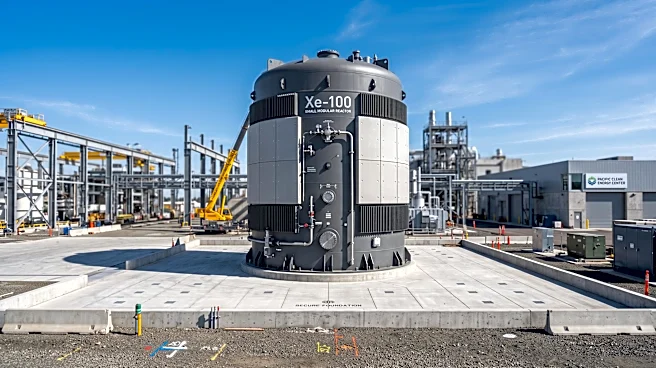
in nearly 60 years and the first-ever for a pebble-bed HTGR and industrial nuclear deployment in the U.S. The project, a collaboration between X-energy and Dow, will feature four Xe-100 advanced small modular reactors at Dow’s UCC Seadrift Operations site. These reactors are designed to provide both electricity and high-temperature steam for industrial use, replacing existing energy assets at the site. The NRC completed its review within an 18-month schedule, evaluating the safety and environmental impacts of the Xe-100 facility. This milestone is part of the U.S. Department of Energy’s Advanced Reactor Demonstration Program (ARDP).
Why It's Important?
This NRC approval is a significant step for the deployment of advanced nuclear technology in the United States, particularly for industrial applications. The Xe-100 reactors are designed to offer clean industrial power for 60 years, contributing to decarbonization efforts and energy independence. The project's ability to provide high-temperature steam directly to an industrial site demonstrates a new application for nuclear energy beyond electricity generation, potentially transforming energy supply for heavy industries. The efficient and timely review by the NRC, as highlighted by NRC Chairman Ho K. Nieh, signals a more predictable regulatory pathway for future advanced nuclear projects, which could accelerate their deployment. This development also supports the broader goal of strengthening American energy leadership and expanding nuclear energy's role in meeting growing energy demands.
What's Next?
Following the CPA approval, X-energy and Dow will continue to advance the project towards construction readiness. This includes finalizing and standardizing the Xe-100 design, maturing the supply chain for long-lead components and materials, and developing an Operating License application for submission to the NRC. Dow is expected to consider a preliminary investment decision in 2027, with full-scale nuclear construction commencing after a final investment decision. The project aims for its first energy delivery in the early 2030s. The successful and timely review of this first-of-a-kind project is expected to create efficiencies for future Xe-100 applications in commercial nuclear licensing, potentially streamlining the regulatory process for similar advanced reactor deployments.
Beyond the Headlines
The approval of the Long Mott Generating Station's construction permit signifies a shift in the U.S. nuclear energy landscape, moving beyond traditional light-water reactors to advanced designs like high-temperature gas-cooled reactors. The Xe-100's intrinsic safety characteristics, including its TRISO-X particle fuel, allow for a significantly smaller emergency planning zone (400 meters compared to 10 miles for conventional reactors), enabling these facilities to be safely sited closer to industrial demand centers. This could lead to a more decentralized and resilient energy infrastructure. The project also highlights the increasing collaboration between government initiatives, such as the ARDP, and private industry in developing and deploying innovative clean energy solutions, potentially setting a precedent for future public-private partnerships in critical infrastructure development.