




What's Happening?
Tokyo Electron, a Japanese semiconductor equipment manufacturer, reported that 36.4% of its latest quarterly sales originated from China. This figure is notably higher than the approximately 20% ASML expects from China for the current year. The bipartisan
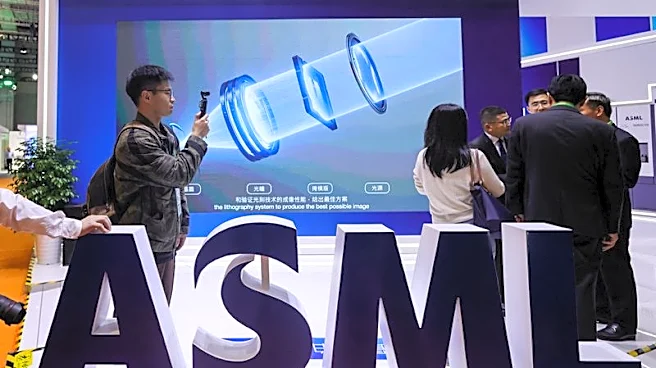
Multilateral Alignment of Technology Controls on Hardware Act (MATCH Act) in the U.S. aims to compel allies, including Japan and the Netherlands, to align with stricter U.S. export controls on semiconductor technology to China. While the bill's current focus appears to be on ASML's immersion machines, its broader application could significantly impact Tokyo Electron, placing it under similar restrictions that its U.S. competitor, Lam Research, already operates under. Lam Research, despite U.S. curbs, still derived 35% of its revenue from China in its September quarter, indicating that such rules do not necessarily eliminate market access.
Why It's Important?
The potential expansion of U.S. semiconductor export controls through the MATCH Act carries substantial implications for global semiconductor supply chains and the financial performance of key equipment manufacturers. For Tokyo Electron, a significant portion of its revenue is at stake, potentially leading to a re-evaluation of its market strategy and sales forecasts. The bill underscores the U.S.'s ongoing efforts to limit China's access to advanced semiconductor technology, aiming to safeguard national security interests and maintain technological leadership. This move could intensify competition among equipment suppliers, as companies like Lam Research, already accustomed to U.S. restrictions, might be better positioned to navigate the evolving regulatory landscape. Conversely, Chinese chipmakers might accelerate their efforts to develop domestic alternatives, fostering self-sufficiency but potentially disrupting established international trade flows.
What's Next?
The MATCH Act could be attached to the U.S. defense authorization bill this year or be taken up in the first quarter of 2027, depending on congressional progress and potential disagreements over other policy matters. Dutch lawmakers have already expressed concerns, with Nicole Maes of the VVD party calling the act 'disastrous for ASML, and therefore also for the Dutch economy.' The final text of the bill will be crucial, as its specific scope—whether it targets only lithography tools or extends to other semiconductor equipment—will determine the full extent of its impact on companies like Tokyo Electron. Stakeholders will closely monitor legislative developments and any subsequent reactions from the Japanese and Dutch governments, as well as from affected companies, as they adapt to potential new export control regimes.
Beyond the Headlines
Beyond the immediate financial and trade implications, the MATCH Act highlights a broader geopolitical struggle for technological dominance. The U.S. is leveraging its economic and political influence to shape global technology policy, pushing allies to adopt similar stances on critical technologies. This strategy could lead to a more fragmented global technology landscape, with distinct supply chains emerging for different geopolitical blocs. For companies like Tokyo Electron, navigating this environment requires not only business acumen but also a deep understanding of international relations and regulatory frameworks. The long-term consequences could include accelerated innovation in certain regions, increased costs for semiconductor manufacturing due to diversified supply chains, and a redefinition of international technological cooperation and competition.