







What's Happening?
The US semiconductor manufacturer Vishay has announced a significant investment in its production facility located in Schleswig-Holstein, a northern German state. While the exact sum was not disclosed by the company, Andreas Hein, economic policy spokesman
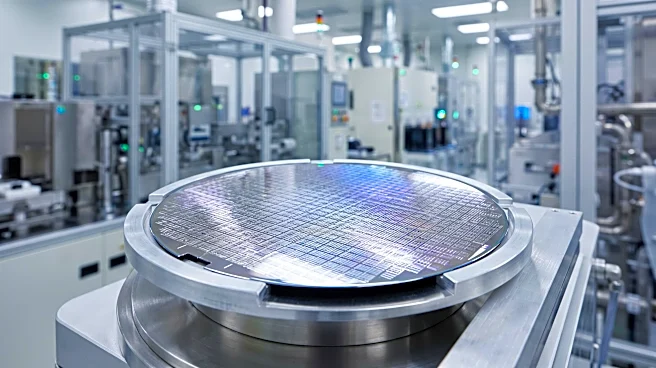
for the Christian Democrats in the state parliament, indicated the investment is approximately €1 billion ($1.11 billion). Schleswig-Holstein's economy minister, Claus Ruhe Madsen, presented a funding approval notice of around €215 million for the Itzehoe site, situated 60 kilometers north-west of Hamburg. This investment will enable Vishay's German subsidiary to produce 300-millimeter semiconductor wafers in a new factory at the location, a significant upgrade from their current production of 200-millimeter wafers. The expansion is projected to create up to 250 new jobs at the facility.
Why It's Important?
This substantial investment by a US chipmaker in Germany underscores the ongoing global efforts to strengthen semiconductor supply chains and increase manufacturing capacity outside of traditional hubs. For the United States, this move by Vishay, a US-based company, contributes to the broader strategy of diversifying semiconductor production, which can enhance resilience against future supply chain disruptions. The production of larger 300-millimeter wafers is crucial as it allows for the manufacturing of more chips and components per disc, leading to increased efficiency and output. This development is particularly important for industries reliant on semiconductors, from automotive to consumer electronics, as it could help alleviate shortages and stabilize prices. The creation of 250 new jobs also highlights the economic impact of such investments, even if located internationally, as it reflects the strategic decisions of US companies in a competitive global market.
What's Next?
Following the funding approval, Vishay's German subsidiary is expected to proceed with the construction of the new factory in Itzehoe. The focus will be on establishing the infrastructure and processes necessary for the production of 300-millimeter semiconductor wafers. The company will likely begin recruitment efforts to fill the up to 250 new positions. This expansion is part of a broader trend of semiconductor companies investing in new facilities and upgrading existing ones to meet increasing global demand and enhance supply chain security. The success of this project could influence future investment decisions by other US-based semiconductor manufacturers looking to expand their international footprint and leverage government incentives in key regions.
Beyond the Headlines
This investment by Vishay reflects a strategic shift in the global semiconductor industry, moving towards greater geographical diversification of manufacturing capabilities. The emphasis on producing larger 300-millimeter wafers signifies a technological advancement aimed at improving efficiency and output, which is critical for meeting the ever-growing demand for advanced electronic components. Beyond the immediate economic benefits and job creation, this move highlights the intricate interplay between national industrial policies and corporate investment strategies. The German government's financial support for Vishay's expansion demonstrates a commitment to fostering high-tech manufacturing within its borders, potentially setting a precedent for other nations seeking to attract similar investments. This trend could lead to a more distributed and resilient global semiconductor ecosystem, reducing reliance on a few concentrated production areas and mitigating risks associated with geopolitical tensions or natural disasters.