





What's Happening?
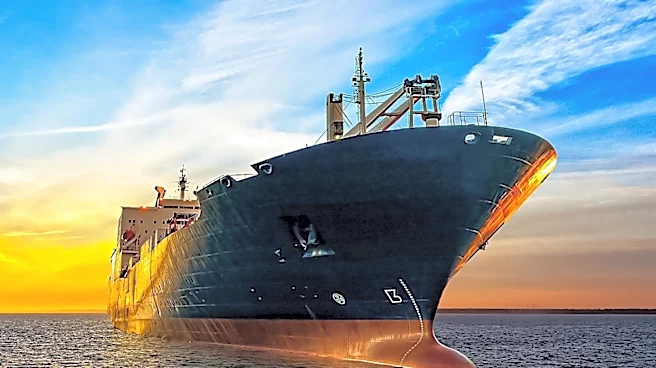
Newlight, a San Francisco Bay Area startup, has developed a hydrogen injection system designed to enhance the efficiency of cargo ship engines and significantly reduce emissions. The retrofit system can be installed in less than two weeks without requiring
a dry dock. According to Newlight, this technology cuts fuel use and emissions by over 20%, potentially saving some vessels up to $500,000 in annual costs. The system works by continuously monitoring the diesel engine and precisely injecting hydrogen fuel at optimal moments, adjusting flow based on factors like exhaust temperature, combustion pressure, and air intake pressure. The startup recently completed its first long-range commercial voyage, an 8,500-nautical-mile trip from Singapore to Ghana, where its system on a Lomar Shipping bulk carrier reduced fuel consumption by 24% and carbon dioxide emissions by 28%.
Why It's Important?
This innovation is crucial for the U.S. and global shipping industries, which are under increasing pressure to reduce their environmental footprint and operational costs. Maritime transport accounts for a significant portion of global greenhouse gas emissions, and Newlight's technology offers a practical and relatively quick solution for existing fleets. By improving fuel efficiency and lowering emissions, the system can help shipping companies comply with stricter environmental regulations, such as those from the International Maritime Organization (IMO), and contribute to broader climate goals. The potential for substantial annual savings also makes it an attractive option for businesses looking to optimize their operations. This development could accelerate the adoption of cleaner technologies in a sector that has historically been challenging to decarbonize, impacting supply chains and trade worldwide.
What's Next?
Newlight has secured a $9 million seed round, with investments from entities like lomarlabs (Lomar Shipping's venture arm) and BIRD Energy (a joint venture between the U.S. Department of Energy and the Israel Ministry of Energy). The company has already signed agreements to install its hydrogen injection system on 12 vessels across multiple companies, with plans for broader fleet rollouts next year. While currently focused on the marine industry, Newlight's co-founders see potential applications beyond shipping, including in transportation and data centers. The immediate next steps involve scaling up installations and continuing to demonstrate the system's effectiveness across a wider range of vessels and operating conditions. The success of these rollouts will be critical in establishing Newlight as a key player in maritime decarbonization.
Beyond the Headlines
The development of Newlight's hydrogen injection system represents a significant step in the broader energy transition, particularly in hard-to-abate sectors like shipping. It highlights the growing trend of retrofitting existing infrastructure with cleaner technologies rather than solely relying on new builds, offering a more immediate pathway to emissions reduction. The collaboration between U.S. and Israeli entities in funding this venture also underscores the international cooperation needed to tackle global climate challenges. Ethically, this technology contributes to corporate social responsibility efforts by enabling companies to reduce their environmental impact. Culturally, it signifies a shift towards valuing sustainable practices in industries traditionally associated with high pollution, potentially influencing consumer and investor expectations for environmentally conscious operations across the supply chain.