


What's Happening?
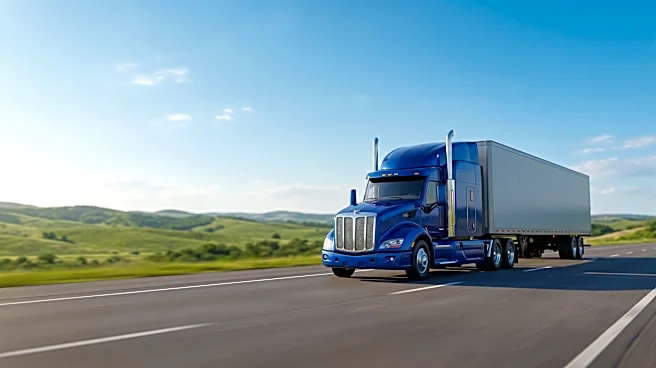
Werner Enterprises, a major transportation and logistics company, is currently in contract negotiations with Aurora Innovation regarding the economic viability of Aurora's driverless truck technology. Daragh Mahon, Executive Vice President and Chief Information
Officer at Werner Enterprises, stated that there is a significant 'gap' in the unit economics that needs to be resolved for the partnership to be commercially viable. Aurora Innovation aims to deploy 30,000 driverless Class 8 trucks by 2030, projecting over $5 billion in revenue, primarily by offloading equipment costs to freight carriers through a 'Driver as a Service' (DaaS) model. However, Werner Enterprises indicates that the current financial model, which expects carriers to bear the capital costs, is not yet working for them. Mahon anticipates that a resolution on the economic feasibility will be determined within the next few months.
Why It's Important?
This development highlights a critical challenge in the widespread adoption of autonomous trucking technology within the U.S. logistics industry. If major freight carriers like Werner Enterprises find the economic model for driverless trucks unfeasible, it could significantly delay or alter Aurora's ambitious deployment targets and revenue projections. The success of autonomous trucking relies heavily on the willingness of carriers to invest in and integrate these technologies. The current standoff suggests that the promised cost savings and efficiencies of driverless trucks are not yet translating into an attractive financial proposition for potential buyers. This could impact the pace of innovation and investment in the autonomous vehicle sector, as well as the broader U.S. supply chain, which stands to benefit from potential improvements in efficiency and safety offered by driverless technology.
What's Next?
Werner Enterprises expects to determine the economic viability of its partnership with Aurora Innovation within the next few months. The outcome of these negotiations will likely influence Aurora's strategy for engaging with other freight carriers and could set a precedent for future agreements in the autonomous trucking industry. If the economic gap cannot be closed, Aurora may need to revise its business model, potentially by taking on more of the capital expenditure itself or by adjusting its pricing structure. The broader industry will be watching closely, as the resolution of these commercial impasses is crucial for the scaling of driverless truck technology. The ability to achieve 'scale where nobody is eating some of the cost,' as Mahon noted, is paramount for the long-term success of autonomous freight operations.
Beyond the Headlines
The friction between Aurora Innovation and Werner Enterprises extends beyond mere contract terms, touching upon fundamental questions of risk allocation and liability in the nascent autonomous vehicle sector. The issue of insurance, for instance, reveals that driverless trucks are currently priced slightly above human drivers due to the untested legal landscape surrounding autonomous liability. This suggests that the perceived benefits of autonomous technology, such as reduced accidents, are not yet fully reflected in insurance premiums, adding to the financial burden on carriers. Furthermore, the reliance on nonbinding memorandums of understanding for significant deployments, such as Aurora's 500-truck deal with Hirschbach Motor Lines, indicates a cautious approach from carriers. This cautiousness, coupled with major shareholders like Uber liquidating Aurora stock, points to a broader skepticism about the immediate financial returns and operational realities of autonomous trucking, despite the technological advancements.