








What's Happening?
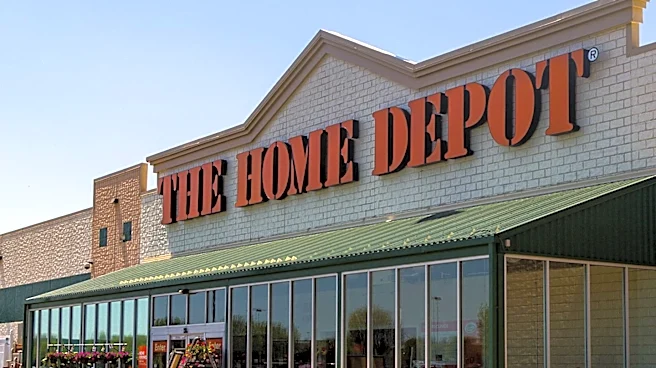
Washington Trust Bank has decreased its holdings in The Home Depot, Inc. (NYSE:HD) by 15.1% in the second quarter, according to its recent 13F filing with the Securities and Exchange Commission. The bank sold 6,584 shares, bringing its total ownership
to 37,096 shares, valued at approximately $13.08 million. This adjustment makes Home Depot the 28th largest position in Washington Trust Bank's portfolio, representing about 0.9% of its total holdings. Concurrently, other institutional investors have made significant changes to their Home Depot stakes. Bank of Nova Scotia acquired a new position worth $118.72 million, while Gator Capital Management LLC and AFT Forsyth & Company Inc. also purchased new positions valued at $3.69 million and $1.90 million, respectively. Field & Main Bank acquired a new stake worth $6.29 million, and King Luther Capital Management Corp increased its position by 0.6%. Overall, hedge funds and other institutional investors collectively own 70.86% of Home Depot's stock.
Why It's Important?
These shifts in institutional ownership reflect varying investment strategies and market outlooks regarding The Home Depot's future performance. While Washington Trust Bank's reduction might signal a cautious approach or portfolio rebalancing, the substantial new acquisitions by other major institutions indicate continued confidence in the company's long-term prospects. The high percentage of institutional ownership (70.86%) suggests that large financial entities view Home Depot as a significant player in the retail sector, influencing its stock stability and liquidity. Insider selling by executives, such as Michael F. Rowe and Teresa Roseborough, who collectively sold shares worth over $1 million, could be interpreted as a signal by some investors, though such sales are often part of routine compensation or diversification strategies. The overall sentiment from analysts remains a 'Moderate Buy' with a consensus price target of $375.54, suggesting that despite some trimming, the broader market still sees value in the home improvement giant.
What's Next?
The Home Depot's stock performance will likely be influenced by ongoing housing market conditions, which management reportedly sees no immediate turnaround for, and the success of its strategic initiatives. The company's focus on expanding its 'Pro customer ecosystem' and investing in technology, such as the AI-powered Magic Apron tools, is expected to drive future growth, particularly in the face of sluggish DIY demand. Analysts will continue to monitor these developments, with some forecasting slight increases in fiscal 2027 EPS while others have cut future EPS estimates for fiscal 2028 and 2029, indicating a mixed outlook on growth acceleration. The upcoming dividend payment on September 17th, with an annualized yield of 2.9%, may continue to attract income-focused investors. The company's ability to navigate a challenging housing environment and leverage its professional contractor segment will be crucial in shaping investor sentiment and future institutional trading decisions.
Beyond the Headlines
The divergent actions of institutional investors highlight the complex factors at play in assessing a large-cap retailer like The Home Depot. Beyond immediate financial metrics, the company's strategic pivot towards a 'Pro focused ecosystem' represents a significant long-term shift. This strategy aims to insulate Home Depot from fluctuations in the DIY market by catering to professional contractors, who often undertake larger, more consistent projects. The integration of AI tools like Magic Apron underscores a broader trend in retail towards technological enhancement to improve customer experience and operational efficiency. However, the success of this strategy hinges on sustained investment and effective integration, which could entail high capital spending and integration risks. The ongoing 'mortgage lock-in' phenomenon, where homeowners are reluctant to move due to lower existing mortgage rates, poses a structural challenge to the home improvement sector, potentially delaying major renovation projects that often follow home sales. This situation places increased pressure on Home Depot's ability to generate growth through its professional segment and technological advancements.