





What's Happening?
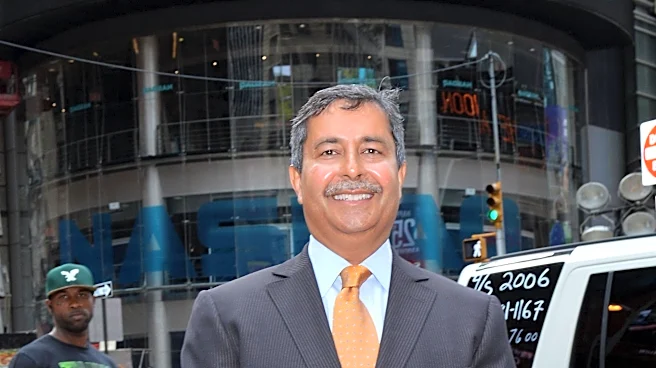
Cole Smead, CEO and portfolio manager at Smead Capital Management, has characterized the current investment surge in artificial intelligence (AI) as the third greatest capital expenditure (capex) mania observed over the past three decades. Speaking on
CNBC's "Squawk Box Europe," Smead discussed the ongoing market sell-off and the recent Anthropic IPO, drawing comparisons between the current AI investment cycle and previous periods of intense capital spending. His analysis suggests that the significant capital flowing into AI development and infrastructure represents a historical pattern of speculative investment, akin to other major technological or industrial shifts that have driven substantial capex cycles in recent history.
Why It's Important?
Smead's assessment highlights a critical perspective on the current AI investment landscape, suggesting that while AI holds transformative potential, the rapid and extensive capital deployment might be indicative of speculative excess. For investors, this perspective serves as a cautionary note, urging a careful evaluation of AI-related investments and the sustainability of current valuations. Understanding this as a 'capex mania' can influence investment strategies, potentially leading to a more cautious approach to companies heavily reliant on AI spending or those with inflated valuations. This viewpoint is crucial for market participants to gauge the long-term viability of AI investments and to differentiate between genuine growth and speculative bubbles, impacting portfolio decisions across various sectors.
What's Next?
If Smead's analysis holds true, the market could anticipate a period of adjustment or consolidation in AI-related investments, similar to the aftermath of previous capex manias. Investors might become more discerning, scrutinizing the profitability and tangible returns of AI companies rather than solely focusing on growth potential. This could lead to increased volatility in the tech sector, particularly for companies heavily invested in AI infrastructure or development. Companies involved in AI may face greater pressure to demonstrate clear pathways to profitability and sustainable business models. The trajectory of the Anthropic IPO and other AI ventures will be closely watched as indicators of market sentiment and the potential for a broader re-evaluation of AI valuations.
Beyond the Headlines
Smead's commentary extends beyond immediate market fluctuations, touching upon the broader economic implications of significant capital misallocation if the AI boom proves to be a speculative bubble. Historically, capex manias have often been followed by periods of economic recalibration, impacting employment, industrial output, and overall market stability. The comparison to previous cycles suggests that while AI technology is revolutionary, the investment patterns surrounding it might follow predictable boom-and-bust cycles. This perspective encourages a deeper look into the underlying fundamentals of AI companies and the potential for long-term value creation versus short-term speculative gains. It also raises questions about the efficient allocation of capital in an era of rapid technological advancement and the potential for systemic risks if investment decisions are driven primarily by hype rather than sound economic principles.