





What's Happening?
Marlowe, an AI infrastructure startup, has successfully raised $277 million in seed funding, achieving a valuation of $1.15 billion. This funding round was led by Accel, with significant participation from various investors including Bessemer Venture
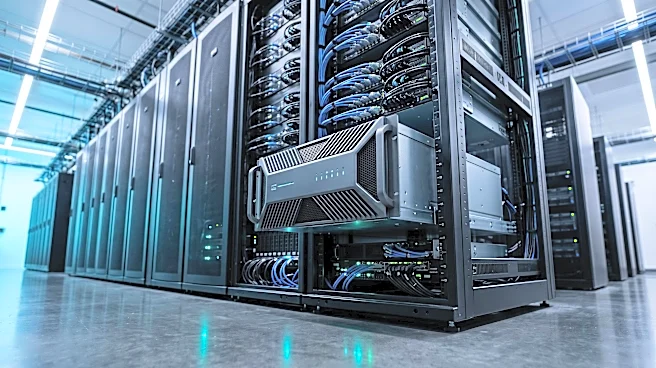
Partners, Altimeter Capital Management, Atreides Management, Eclipse, Journey, Valor, Neo, and a broad group of angel investors such as Aaron Levie, Dara Khosrowshahi, Henry Kravis, Nikesh Arora, Drew Houston, and Tony Xu. The company aims to specialize in AI inference workloads, designing, building, and operating compute systems specifically for this purpose, rather than for training. Marlowe's strategy focuses on a multi-silicon approach to improve AI inference performance and reduce dependency on Nvidia chips. The capital includes an earlier, smaller commitment led by Eclipse. The company's core argument is that the demand for inference is growing faster than current capacity, and running all workloads on general-purpose hardware is inefficient given power constraints and rising construction costs.
Why It's Important?
This significant investment in Marlowe highlights a critical shift in the AI infrastructure landscape, moving towards specialized solutions for inference workloads. The current reliance on general-purpose hardware, particularly Nvidia's ecosystem, is becoming increasingly inefficient and costly as AI inference demand escalates. Marlowe's approach to co-designing and optimizing compute systems for specific inference tasks could lead to substantial gains in performance, efficiency, and cost-effectiveness for U.S. businesses and industries heavily investing in AI. By offering alternatives to the dominant Nvidia platform, Marlowe could foster greater competition and innovation in the AI hardware market, potentially reducing single-supplier exposure and improving utilization rates for companies. This development is crucial for the continued expansion and practical application of AI across various sectors, from coding agents to real-time voice processing, by making AI more accessible and affordable.
What's Next?
Marlowe plans to use the newly acquired capital to fund chip and networking hardware purchases, site development, and team expansion. The company's initial deployment strategy includes a first site, built around Etched chips, primarily for a large AI coding customer, expected to begin operations in the near term. A second, larger facility utilizing AMD’s Helios rack systems is targeted for the second quarter of 2027. A third site is also under a letter of intent. Marlowe has reported three signed customer agreements, though the customers and exact site locations or power capacities have not been disclosed beyond a general plan for facilities measured in tens of megawatts. The coming months will be critical for Marlowe to demonstrate its claimed two to three times advantage in performance, efficiency, availability, and cost under real customer loads, which will test the viability of its specialized AI inference infrastructure model.
Beyond the Headlines
Marlowe's emergence and substantial funding underscore a broader trend in the technology sector: the increasing specialization and optimization of hardware for specific AI tasks. This move away from a one-size-fits-all approach for AI computing has profound implications for the future of artificial intelligence. It suggests a future where AI development is not solely dictated by the capabilities of general-purpose GPUs but by a diverse ecosystem of specialized silicon tailored for different inference needs. This could democratize access to advanced AI capabilities, allowing more companies to deploy sophisticated AI models without prohibitive costs or reliance on a single vendor. Furthermore, the focus on energy efficiency and cost reduction addresses critical environmental and economic concerns associated with the escalating computational demands of AI, potentially leading to more sustainable and scalable AI solutions in the long term.