






What's Happening?
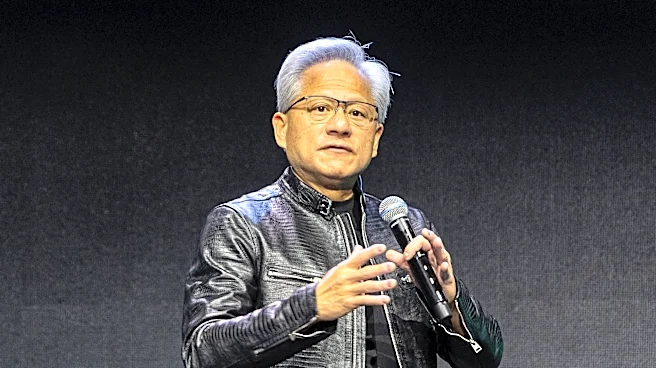
NVIDIA CEO Jensen Huang has resigned from his position due to an alleged improper relationship with a direct report, Kimberly Powell, the head of NVIDIA's healthcare business. This development follows an earlier apology Huang issued to employees regarding
a relationship with Alice Huang, a senior executive at Singapore-based Megaspeed. While the initial apology attempted to frame the issue as a private matter, the subsequent revelation of the relationship with Powell, a direct subordinate, escalated the situation to a level that, by U.S. corporate governance standards, is considered a clear violation. The board of directors reportedly requested Huang's resignation, which he submitted around mid-November. This incident has drawn comparisons to other high-profile executive departures and has raised questions about corporate governance, particularly in the context of NVIDIA's historically flat organizational structure where approximately 60 individuals reported directly to Huang.
Why It's Important?
Jensen Huang's resignation from NVIDIA, a leading U.S. technology company, carries significant implications for the semiconductor industry and corporate governance standards. NVIDIA's dominant position in the GPU market, especially for AI applications, means that leadership changes can introduce substantial uncertainty for investors, partners, and the broader tech ecosystem. The nature of his departure—stemming from an improper relationship with a direct report—underscores the increasing scrutiny on executive conduct and corporate ethics in the U.S. This incident highlights the importance of robust corporate governance frameworks, particularly in preventing conflicts of interest and maintaining a professional work environment. For NVIDIA, the challenge lies in finding a successor who can maintain the company's innovative trajectory and market leadership while navigating potential internal cultural shifts. The event could also prompt other U.S. companies to review and reinforce their internal policies regarding executive relationships and reporting structures, aiming to mitigate similar risks.
What's Next?
NVIDIA faces the immediate challenge of appointing a new CEO. Potential successors mentioned include Johny Srouji from Apple, talent from Arm, internal CTO-level candidates, and former CFO Colette Kress, who is currently serving as interim CEO. The selection of a new leader will be critical in determining NVIDIA's future strategic direction and maintaining investor confidence. The company's unique flat organizational structure, where many executives reported directly to Huang, is expected to undergo significant changes under new leadership, potentially leading to cultural shifts. Additionally, there are ongoing investigations by Congress into alleged GPU exports to China via Megaspeed, a company linked to Alice Huang. Jensen Huang is expected to testify before Congress in December regarding these allegations. The outcome of these investigations and the new leadership's approach to supply chain compliance will be crucial for NVIDIA's international operations and reputation.
Beyond the Headlines
The resignation of Jensen Huang transcends a typical executive departure, delving into deeper issues of power dynamics, corporate culture, and the 'founder's dilemma' in high-growth tech companies. Huang's 'superhuman' leadership style, characterized by a flat organizational structure, allowed NVIDIA to thrive for 33 years but also concentrated immense power, potentially making the company vulnerable to personal conduct issues. This incident prompts a re-evaluation of whether such highly centralized leadership models are sustainable or desirable in modern corporate environments, especially as companies grow in size and public scrutiny. The comparison to other tech leaders like Elon Musk and Jeff Bezos, who have faced personal controversies, highlights a broader societal debate about the separation of private life and professional responsibilities for influential figures. Furthermore, the ongoing congressional investigation into alleged illicit GPU exports to China adds a geopolitical layer, suggesting that executive conduct can have far-reaching implications for national security and international trade relations, potentially leading to FBI involvement if 'benefit transfer' is proven. The incident could serve as a case study for future corporate governance reforms in the U.S. tech sector.