






What's Happening?
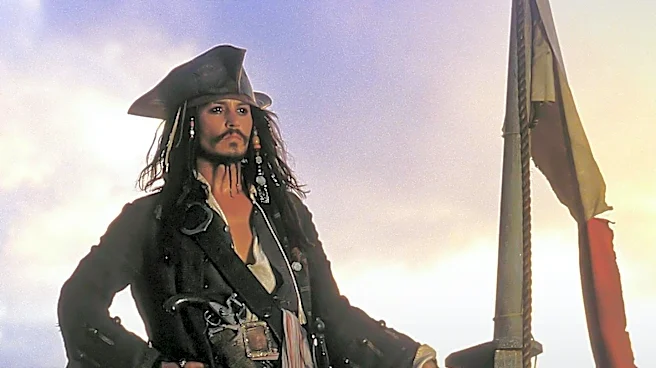
Johnny Depp's initial depiction of Captain Jack Sparrow in "Pirates of the Caribbean: The Curse of the Black Pearl" is being highlighted for its effectiveness in establishing the character's personality within the first minute of his appearance. The introduction
showcases Jack Sparrow arriving in Port Royal on a sinking, dilapidated boat, yet maintaining an air of nonchalant confidence. Despite the chaotic circumstances, he navigates the situation with a unique blend of controlled chaos, paying off an officer to avoid giving his name, and immediately swiping a money bag. The scene also subtly reveals a rare moment of empathy when he salutes the heavily decomposed bodies of hanged pirates, indicating a deeper, more complex character beneath his mischievous exterior. This immediate and multifaceted portrayal set the stage for the character's evolution throughout the film series.
Why It's Important?
This analysis of Johnny Depp's portrayal of Captain Jack Sparrow underscores the critical role of character introductions in filmmaking and their lasting impact on popular culture. A well-crafted introduction, as demonstrated by Depp's performance, can instantly define a character's core traits, making them memorable and engaging for audiences. This is important for the entertainment industry as it highlights the value of strong acting and directorial choices in creating iconic figures that resonate globally. For U.S. film studios, it serves as a case study in successful character development, influencing future casting and narrative strategies. The character's blend of moral ambiguity with moments of genuine care also reflects evolving audience preferences for complex anti-heroes, impacting how studios approach character writing and audience engagement.
What's Next?
The continued discussion and analysis of iconic character introductions, such as Captain Jack Sparrow's, will likely influence future filmmaking practices, particularly in the U.S. entertainment industry. Directors and screenwriters may increasingly focus on crafting highly impactful opening scenes to immediately hook audiences and establish character depth. This trend could lead to more innovative and nuanced character introductions in upcoming films and television series. Furthermore, the enduring popularity of characters like Jack Sparrow may encourage studios to revisit and re-evaluate their approaches to franchise development, potentially leading to new interpretations or spin-offs that build upon established character foundations. The emphasis on subtle character traits and their evolution will also likely remain a key element in critical and academic discussions of cinematic storytelling.
Beyond the Headlines
The enduring appeal of Captain Jack Sparrow, largely attributed to Johnny Depp's initial portrayal, extends beyond mere entertainment, touching upon broader cultural and psychological themes. The character's ability to blend controlled chaos with unexpected empathy speaks to a human fascination with figures who defy easy categorization. This complexity challenges traditional hero/villain archetypes, reflecting a societal shift towards appreciating more nuanced personalities in media. Ethically, Jack Sparrow's morally ambiguous actions, juxtaposed with his moments of genuine care, provoke thought on the nature of good and evil, and how these concepts are perceived and reconciled within individuals. Culturally, his iconic status has cemented his place in global pop culture, influencing fashion, language, and even tourism, demonstrating the profound impact a well-conceived character can have on collective imagination and identity.