

What's Happening?
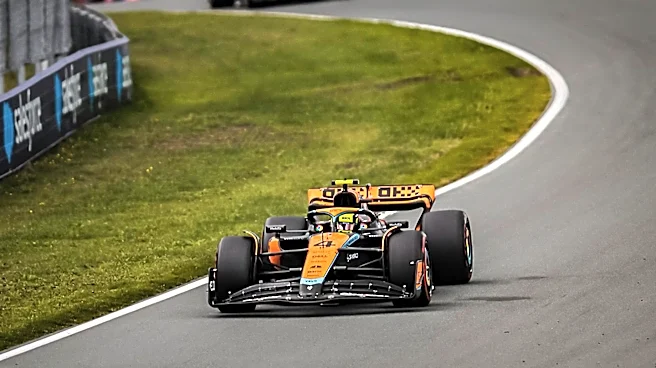
McLaren driver Lando Norris has voiced concerns regarding the potential for 'scary times' at the upcoming Las Vegas Grand Prix, specifically due to difficulties in getting tires up to optimal temperature in cold conditions. Following his third victory
of the season at the Brazilian Grand Prix, which took place on a cold and wet Interlagos circuit, Norris highlighted that while current and previous generation cars manage wet conditions similarly, the challenge of warming up tires could be significantly worse in Las Vegas. He noted that tires feel 'horrible' when very cold, and while they perform well once in a good window, achieving that window in colder environments like Las Vegas could be problematic. Norris emphasized the need for a 'much better tire' for such conditions, contrasting it with Interlagos, which he described as one of the best circuits for tire temperature management.
Why It's Important?
Lando Norris's concerns about tire performance in cold conditions at the Las Vegas Grand Prix are significant for several reasons. Firstly, tire temperature is crucial for grip and safety in Formula 1, directly impacting driver control and the risk of accidents. If drivers struggle to warm their tires, it could lead to a more unpredictable and potentially dangerous race, affecting both competitive fairness and driver well-being. Secondly, this issue highlights a potential design limitation in current F1 tires, suggesting that their working range might be too narrow for extreme cold conditions. This could prompt discussions between teams, Pirelli (the tire supplier), and the FIA (motorsport's governing body) about future tire development and safety protocols. The unique characteristics of the Las Vegas street circuit, combined with potentially low temperatures, could expose these tire limitations more acutely than other venues.
What's Next?
Following Lando Norris's public comments, it is likely that the concerns regarding tire performance at the Las Vegas Grand Prix will be a key topic of discussion among Formula 1 teams, drivers, Pirelli, and the FIA. Teams will undoubtedly be preparing strategies to manage tire temperatures, potentially experimenting with different setups and warm-up procedures during practice sessions. Pirelli may face pressure to address these concerns, either through immediate recommendations for tire usage or by considering future tire compounds with a wider working range. The FIA will also monitor the situation closely, especially during initial practice sessions in Las Vegas, to ensure driver safety. Depending on the severity of the issue, there could be adjustments to track operations or even discussions about future circuit design considerations for colder climates.
Beyond the Headlines
The discussion around tire performance in cold conditions at the Las Vegas Grand Prix extends beyond immediate race safety to broader implications for Formula 1's technical regulations and event planning. It underscores the complex interplay between vehicle technology, environmental factors, and circuit design. If tire issues prove significant, it could lead to a re-evaluation of how F1 races are scheduled in colder climates or at night, where temperatures drop. Furthermore, it highlights the continuous challenge for tire manufacturers to produce compounds that perform optimally across a vast range of conditions, balancing grip, durability, and safety. This situation could also influence future tire development, pushing for innovations that offer greater flexibility in temperature windows, ultimately enhancing both performance and safety across the diverse global calendar of Formula 1.