



What's Happening?
Director Casper Kelly, known for the viral short 'Too Many Cooks,' has released a new film titled 'Buddy.' The movie delves into surrealist horror by setting its narrative within the framework of a children's television show, reminiscent of 'Barney &
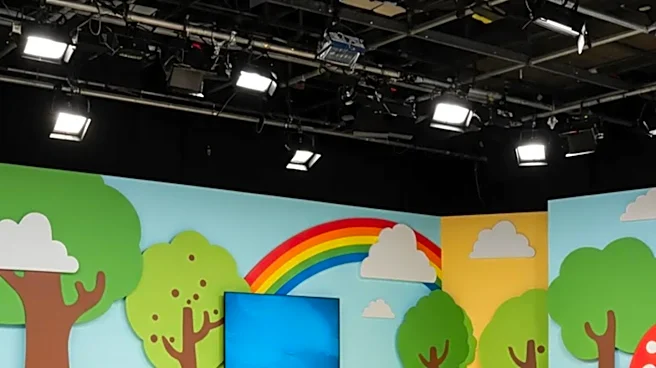
Friends.' In 'Buddy,' a giant orange unicorn named Buddy (voiced by Keegan-Michael Key) acts as the supreme dictator of a self-contained bubble universe. This universe is populated by children who cannot recall how they arrived there. The film, co-written by Kelly and Jamie King, focuses on Freddy, played by Delaney Quinn, one of the children who realizes the oppressive nature of Buddy's world and the disappearance of other kids. Kelly and production designer Anna Kathleen meticulously craft a crayon-hued, copyright-abiding world that evokes a distorted sense of childhood memory, featuring off-brand characters like Mailman Miles and Strappy the Backpack (voiced by Patton Oswalt). The horror in 'Buddy' is not overtly scary but rather establishes a profound sense of unease by exploiting the artificial discomfort and unhinged conventions often found in children's TV.
Why It's Important?
Casper Kelly's 'Buddy' is significant for its unique approach to the horror genre, moving beyond conventional scares to explore psychological unease within a seemingly innocent setting. This film challenges audience perceptions of children's entertainment, highlighting how familiar and comforting elements can be twisted into something disturbing. The movie's exploration of a 'Barney the Dinosaur'-esque character as an 'evil, world-bending autocrat' offers a commentary on control and manipulation, themes that resonate beyond the fictional universe. For the entertainment industry, 'Buddy' represents a creative risk that could influence future horror productions to experiment with less obvious sources of terror. It also showcases the continued evolution of independent filmmaking, where directors like Kelly can leverage their distinct visions to create impactful and thought-provoking content. The film's ability to generate 'gleefully uncomfortable' feelings suggests a growing appetite among audiences for genre-bending narratives that defy easy categorization.
What's Next?
The reception of 'Buddy' could influence future projects by Casper Kelly and other filmmakers interested in exploring similar themes of surrealist horror and psychological unease within unexpected contexts. If the film garners critical acclaim and audience engagement, it may encourage more studios to invest in unconventional horror narratives that prioritize atmosphere and thematic depth over jump scares. The film's unique premise and execution could also spark discussions within the entertainment industry about the boundaries of children's programming and the potential for darker interpretations of seemingly innocuous content. Furthermore, the success of 'Buddy' might pave the way for more collaborations between Kelly and actors like Keegan-Michael Key and Patton Oswalt, who lend their voices to the film, potentially leading to more projects that blend comedy and horror in innovative ways. The film's impact on the independent film circuit will be closely watched as a barometer for audience interest in experimental genre cinema.
Beyond the Headlines
Beyond its immediate impact as a horror film, 'Buddy' touches upon deeper cultural and psychological implications. The film's premise, which reimagines a beloved children's character as an authoritarian figure, can be seen as a commentary on the subtle ways power and control are exerted, even in seemingly benign environments. This subversion of childhood innocence into a source of dread taps into a collective unease about the hidden aspects of familiar institutions. Ethically, the film prompts reflection on the content consumed by children and the potential for underlying messages, however unintentional, to shape perceptions. Culturally, 'Buddy' contributes to a growing trend in media that re-examines nostalgic elements through a darker lens, challenging audiences to confront uncomfortable truths about their past and present. The film's ability to create 'uncanny verisimilitude' in its fictional world highlights the power of storytelling to construct believable realities, even when those realities are deeply unsettling.