






What's Happening?
The European Space Agency (ESA) is currently assessing whether Europe's existing rocket launch capabilities can meet a projected surge in satellite launch demand, which is expected to peak around 2030. ESA Director General Josef Aschbacher has indicated
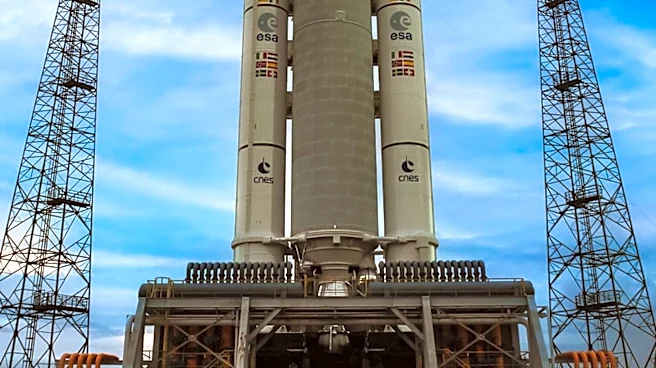
that a decision on expanding launch capacity has not yet been made, despite the urgent need. This review comes as France-based Arianespace, a commercial launch provider, anticipates nine to ten annual Ariane 6 launches starting in 2027. Amazon has already commissioned 18 launches, adding significant commercial requirements. The ESA also continues to utilize Ariane 6 and Vega-C for its institutional missions. The agency is also funding several new European rocket companies through the European Launcher Challenge program to diversify its supply beyond the current workhorse rockets, Ariane 6 and Vega-C, which handle larger and smaller satellite payloads, respectively. This initiative aims to broaden Europe's launch options and foster competition among providers.
Why It's Important?
This assessment is crucial for Europe's strategic autonomy in space and its ability to compete in the global satellite launch market. The increasing demand, particularly from major commercial entities like Amazon, highlights a potential bottleneck in European launch services. If Europe fails to expand its capacity, it risks losing significant commercial contracts to international competitors, impacting its space industry's revenue and technological advancement. Furthermore, ensuring sufficient launch capabilities is vital for European institutional missions, including scientific research, Earth observation, and security applications. The investment in new private rocket companies through the European Launcher Challenge is a strategic move to foster innovation, create a more robust and competitive launch ecosystem, and reduce reliance on a limited number of providers. This diversification is essential for long-term resilience and growth in the rapidly expanding space sector.
What's Next?
The ESA is expected to make a decision soon regarding the expansion of its rocket launch capacity, as stated by Director General Josef Aschbacher. This decision will likely involve evaluating the feasibility of increasing production, investing in new infrastructure, and potentially scaling up operations for existing and emerging launch providers. The companies participating in the European Launcher Challenge, such as Rocket Factory Augsburg, PLD Space, and Isar Aerospace, are required to achieve an orbital launch before 2028. Successful launches from these companies could significantly broaden Europe's available launch services beyond Ariane 6 and Vega-C. The ESA also anticipates continuing its contract process with MaiaSpace, another participant in the European Launcher Challenge. Future orders from Amazon and other commercial entities will further influence the demand landscape and the urgency of these capacity decisions.
Beyond the Headlines
The ongoing review by the ESA extends beyond mere logistical considerations; it touches upon Europe's ambition for 'space sovereignty.' By investing in a diverse range of launch providers and assessing its capacity, Europe is strategically positioning itself to control its access to space, reducing dependence on non-European launch services. This push for self-reliance has significant geopolitical implications, ensuring that critical European satellite infrastructure and scientific missions are not subject to external political or economic pressures. The development of smaller, more agile launch vehicles by companies like Rocket Factory Augsburg, PLD Space, and Isar Aerospace also signifies a shift towards a more dynamic and competitive space industry, mirroring trends seen in the U.S. This could lead to lower launch costs, increased innovation, and greater accessibility to space for a wider range of applications, from Earth observation to telecommunications.