



What's Happening?
San Francisco-based startup Marathon Fusion announced in October 2026 that it has successfully converted mercury into gold using neutrons generated through nuclear fusion. This scientific development, if independently verified, marks a potential breakthrough
in the long-sought alchemical dream. The company's modeling suggests that a future commercial fusion plant could produce approximately five tonnes of gold annually per gigawatt of electricity-generating capacity. However, this production estimate is based on future technological capabilities rather than existing industrial operations. The process involves changing the nucleus of mercury-198, a specific isotope, into gold-197 through a nuclear reaction. This differs significantly from lab-grown diamonds, which are created by replicating natural conditions. The company acknowledges several challenges, including the need for commercial nuclear fusion facilities, the complex separation of the required mercury-198 isotope from naturally occurring mercury, and the management of radioactive byproducts.
Why It's Important?
The potential for lab-grown gold, while scientifically intriguing, faces substantial economic and logistical obstacles that could prevent it from disrupting the global gold market in the near future. Unlike lab-grown diamonds, which offer a cheaper alternative to mined diamonds, artificially produced gold would be chemically identical to mined gold, meaning there is no inherent 'cheaper' product to attract buyers. The current global gold supply is around 5,002 tonnes annually, with mine production accounting for 3,672 tonnes. Marathon Fusion's estimated five tonnes per plant would represent a mere 0.1% of the 2025 global supply, making a significant impact on prices or demand unlikely. Furthermore, the process generates radioactive material requiring 14 to 18 years of storage for decay before commercial use, creating a substantial delay between production and market availability. This technology would also require massive investment in fusion infrastructure and reliable production systems.
What's Next?
For Marathon Fusion's technology to become commercially viable, several critical milestones must be achieved. These include independent verification of their results, disclosure of actual production quantities and costs, successful development of a method to separate the required mercury-198 isotope, and the establishment of commercial nuclear fusion facilities. Even if a commercial plant were operational by the 2030s, the gold produced might not be available for sale until the late 2040s due to the necessary storage period for radioactive decay. Additionally, the gold industry would need to establish regulatory frameworks and certification processes for lab-grown gold to be accepted by banks and international exchanges, especially given its production involves radioactive materials. The market will be watching for evidence that production can be scaled economically and that the purity of the material can be verified.
Beyond the Headlines
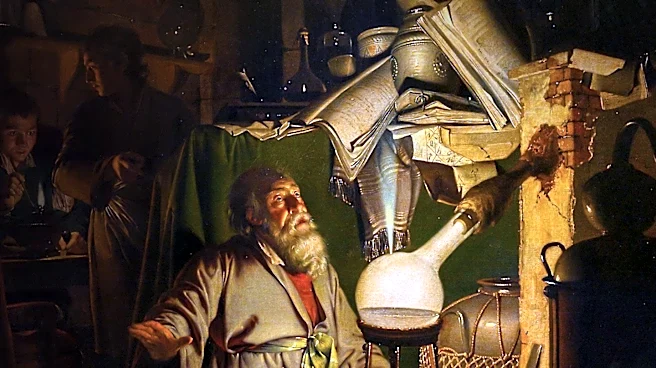
The concept of converting mercury to gold through nuclear processes raises profound questions beyond immediate commercial viability. It highlights the ongoing scientific pursuit of manipulating fundamental elements, a modern-day alchemy driven by advanced physics rather than mystical practices. The ethical and environmental implications of large-scale nuclear fusion for material production, particularly concerning radioactive waste management and the long-term storage requirements, will be critical considerations. The development also underscores the distinction between scientific achievement and commercial practicality, demonstrating that a breakthrough in the lab does not automatically translate into a market-ready product. The cultural and investment significance of gold, particularly in regions like the Middle East, suggests that market acceptance of lab-grown gold would depend not only on its chemical identity but also on its provenance and the perceived value of its production method.