
What's Happening?
Chinese technology company XPeng, known for its electric vehicles, is preparing for the mass production of its general-purpose humanoid robot, Iron, with commercial operations scheduled to begin in January
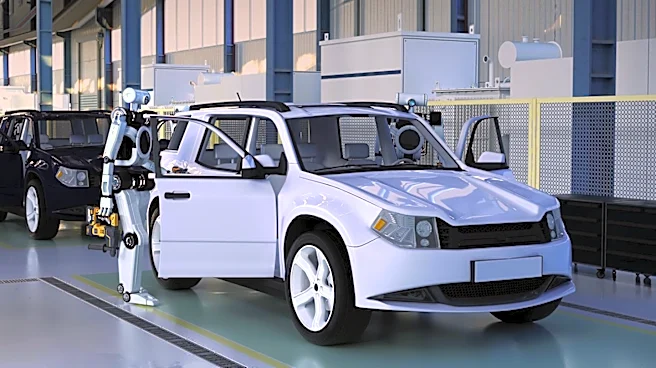
2027. Unveiled at its AI Day 2026 event in Guangzhou, the latest generation of Iron features 76 degrees of freedom, including a dexterous hand with 21 degrees of freedom, over 1,500 tactile sensing points, 3D vision, and 360-degree environmental perception. The robot is powered by three proprietary Turing AI chips, providing a combined 2,250 trillion operations per second of computing power. XPeng's approach involves the simultaneous development of the robot's intelligence and physical capabilities, utilizing its Turing physical AI architecture for reasoning, task planning, real-time decision-making, and physical control. The company has established a 50,000 sq m Robot Data Factory and an automated production line designed to produce one Iron humanoid robot every 2.5 minutes at full capacity.
Why It's Important?
XPeng's move into mass-producing humanoid robots signifies a major advancement in the global robotics industry, with potential implications for the U.S. market. While XPeng is a Chinese company, the rapid development and commercialization of humanoid robots by international players will inevitably influence the competitive landscape and technological benchmarks for U.S. robotics firms. The deployment of Iron robots as store assistants in XPeng's retail stores, and their potential for broader applications in reception, education, and industrial operations, demonstrates a practical, value-driven approach to robotics. This could accelerate the adoption of humanoid robots in various service and industrial sectors within the U.S., driving innovation and potentially creating new job categories related to robot management and maintenance. U.S. companies will need to monitor these developments closely to remain competitive in the evolving AI and robotics space.
What's Next?
Mass production of the Iron humanoid robot is slated to begin in January 2027. The initial deployment will see Iron robots training as store assistants in XPeng's retail stores during the first quarter of 2027, where they will welcome customers and provide product guidance. Beyond retail, XPeng envisions applications in reception services, education, exhibition guidance, and industrial operations. The company plans to develop a commercial model that includes hardware sales, software subscriptions, and an open robotics ecosystem to allow developers and businesses to create new robotic skills. This strategy aims to ensure that the robots continuously acquire commercially useful capabilities throughout their operational lives, making software and robotic skills as crucial as the hardware itself.
Beyond the Headlines
The mass production of humanoid robots like XPeng's Iron marks a pivotal moment in the integration of artificial intelligence into daily life and industry. This development raises profound questions about the future of human labor, the ethical implications of autonomous systems, and the societal impact of widespread robot adoption. As these robots become more capable and ubiquitous, discussions around job displacement, the need for new human skills, and the regulatory frameworks governing AI and robotics will intensify. The concept of an 'open robotics ecosystem' suggests a future where robots are highly customizable and adaptable, potentially leading to unforeseen applications and challenges. This shift could fundamentally alter economic structures and social interactions, requiring careful consideration from policymakers, businesses, and civil society groups in the U.S. and globally.