








What's Happening?
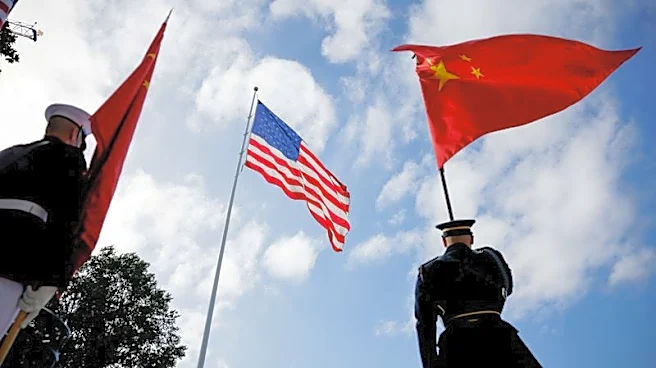
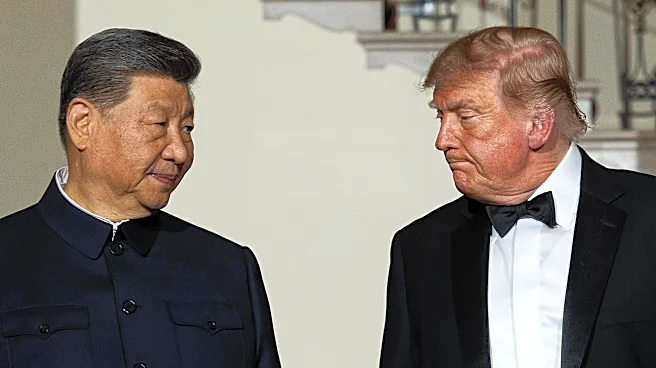
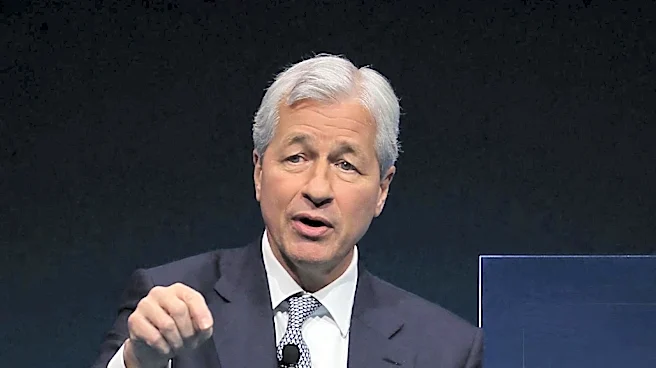
Jamie Dimon, CEO of JPMorgan Chase, has issued a stark warning regarding the U.S.-China technology competition, characterizing it as a long-term global struggle for control over critical technologies. Dimon emphasizes that this rivalry extends beyond
trade disputes or short-term policy clashes, encompassing supply chains, artificial intelligence (AI), semiconductors, and national security. He asserts that the United States must reduce its dependence on China for essential goods, protect military-relevant technologies, and commit to sustained innovation to maintain its competitive edge. Dimon's perspective highlights the structural weaknesses that could be exploited if the U.S. fails to address its vulnerabilities, particularly in areas like critical supply chains for medicines and rare earth minerals. He views semiconductors as strategic assets, noting that control over these components translates to economic leverage and military capability. Dimon also points out China's significant advancements in areas like electric vehicle manufacturing and AI deployment, cautioning against underestimating China's technological strength.
Why It's Important?
This warning from a prominent financial leader like Jamie Dimon underscores the profound implications of the U.S.-China tech competition for the American economy and national security. The struggle for technological dominance directly impacts national security and military capabilities, economic growth, control of critical supply chains, and global technology standards. Dimon's emphasis on reducing dependence on China highlights a critical vulnerability for the U.S., where disruptions in supply chains for essential goods could have immediate and severe consequences across healthcare, defense, and industry. The competition in AI and semiconductors is particularly crucial, as these technologies are foundational to modern military hardware, communication networks, and economic productivity. Losing control over core technologies, as Dimon suggests, could lead to a loss of national independence. The reshaping of markets due to this competition means businesses face higher compliance costs, supply chain restructuring, increased geopolitical risk, and shifting investment flows, impacting profitability and operational stability for U.S. companies.
What's Next?
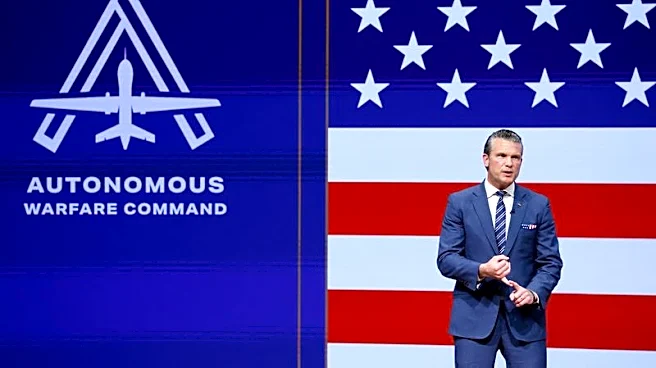
In response to the escalating tech competition, Dimon advocates for a focused U.S. strategy that includes rebuilding domestic manufacturing for critical goods, significantly investing in science, engineering, and AI, and streamlining regulations without compromising safety. He also stresses the importance of close coordination with allies and precisely protecting military-relevant technologies. The U.S. is expected to continue implementing measures like export controls on advanced chips and the CHIPS Act to bolster its domestic semiconductor industry and safeguard national security. While competition is inevitable, there is also a recognition of the need for cooperation with China on addressing AI risks, as both nations share incentives to prevent AI systems from causing socio-political havoc or being misused. Future dialogues and communication channels between the U.S. and China on AI safety are anticipated, aiming to establish practical safeguards and prevent an AI arms race.
Beyond the Headlines
The U.S.-China tech competition extends beyond economic and military considerations, touching upon deeper ethical and cultural dimensions. Dimon's critique of the U.S. system's short-term thinking, contrasted with China's long-term strategic planning, highlights a fundamental difference in approach that could have lasting consequences for innovation and global leadership. The competition also involves a struggle for influence in emerging economies, where China's heavy investments in digital infrastructure are shaping future technology adoption and global standards. This aspect suggests a broader geopolitical contest for technological and economic leadership that will define the global order for decades. The debate over open-source AI models versus technological decoupling also raises questions about the future of global technological collaboration and the potential for self-isolation to create new risks rather than enhance security. The challenge lies in balancing aggressive competition in critical technologies with necessary cooperation on shared global risks, particularly in rapidly evolving fields like AI.