




What's Happening?
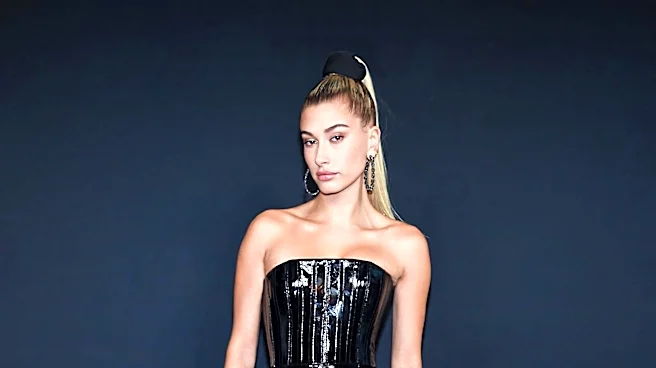
Hailey Bieber recently attended The New York Times DealBook Summit in New York City, where she participated in a discussion about her business ventures. For the event, Bieber wore a Yohji Yamamoto Spring 1998 ensemble, consisting of a corset-style jacket
and a white pencil skirt. This particular outfit was famously worn by Carolyn Bessette-Kennedy in the same year it was released. Notably, this archival piece had previously been loaned to Ryan Murphy's production of 'Love Story' for actress Sarah Pidgeon, though it ultimately did not appear in the final cut of the production. Bieber completed her look with a slim black headband, further emphasizing a 1990s aesthetic and drawing parallels to Bessette-Kennedy's minimalist style. The ensemble, nearly three decades old, was highlighted for its continued relevance and elegant tailoring in a business setting.
Why It's Important?
This event highlights the enduring influence of archival fashion and the cyclical nature of style trends, particularly the resurgence of 1990s aesthetics in contemporary fashion. Hailey Bieber, a prominent figure in the 'clean-girl aesthetic,' choosing a vintage piece previously worn by a style icon like Carolyn Bessette-Kennedy, underscores the impact of historical fashion on current celebrity and public style. The fact that the outfit was initially considered for a production involving Sarah Pidgeon also points to the intersection of fashion, entertainment, and historical homage. Such high-profile appearances in vintage designer wear can significantly boost the visibility and desirability of archival collections, influencing both luxury resale markets and mainstream fashion trends. It also demonstrates how celebrities can leverage their platforms to bring attention to sustainable fashion practices through re-wearing or repurposing existing garments.
What's Next?
The continued visibility of archival fashion on prominent figures like Hailey Bieber suggests a sustained trend towards vintage and sustainable fashion choices in the entertainment and public spheres. This could lead to increased demand for designer vintage pieces and potentially influence fashion houses to re-examine their archives for inspiration or re-release iconic designs. For Sarah Pidgeon, while the outfit didn't make it into her production, the mention connects her to a significant fashion moment, potentially raising her profile within fashion circles. The broader impact might include more designers and stylists incorporating historical pieces into contemporary wardrobes, further blurring the lines between past and present fashion trends and encouraging a more circular approach to clothing consumption.
Beyond the Headlines
Beyond the immediate fashion statement, this event touches upon several deeper implications. It underscores the cultural power of celebrity endorsement in shaping trends and perceptions of value in fashion. The narrative of an outfit having a 'second life' on a different public figure, after being considered for a fictional portrayal, highlights the fluidity of fashion's journey through different contexts—from runway to real-life icon, to potential screen portrayal, and back to contemporary public appearance. This also subtly speaks to the growing conversation around sustainability in fashion, where re-wearing and appreciating existing garments is gaining traction as an alternative to constant new consumption. The choice of a Yohji Yamamoto piece also points to the enduring legacy of avant-garde designers whose work continues to resonate decades later, influencing modern aesthetics and challenging fast-fashion norms.