







What's Happening?
TJX Companies, the parent company of TJ Maxx and Marshalls, announced a slowdown in sales at its discount apparel chains during the second quarter. This deceleration occurred despite the company reporting strong growth in its home goods business. Quarterly
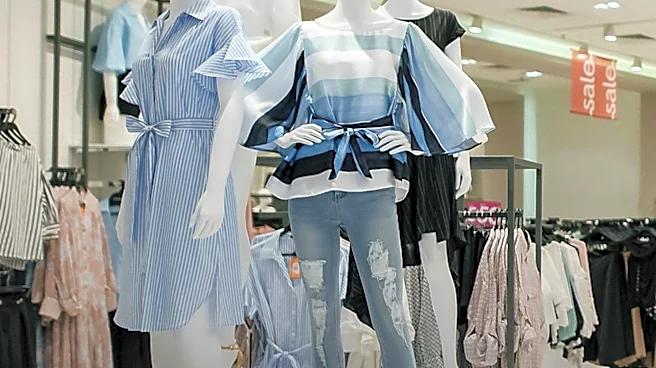
net sales for TJX rose 5.4 percent to $15.18 billion, slightly exceeding estimates of $15.16 billion. Adjusted earnings per share increased by 11 percent to $1.22, surpassing expectations of $1.19. However, the weaker performance in the core apparel-focused Marmaxx division, which saw comparable sales growth slow to 1 percent from 6 percent in the previous quarter, has raised concerns about a potential pullback in U.S. consumer spending. CEO Ernie Herrman acknowledged that the company 'could have executed our store mix better' at TJ Maxx and Marshalls, citing a lack of certain basic and 'impulse-driven' items on shelves. Shares of TJX Companies fell approximately 4.2 percent following the announcement.
Why It's Important?
The reported slowdown at TJ Maxx and Marshalls is significant as it points to potential shifts in U.S. consumer behavior, particularly in discretionary spending on apparel. While TJX's overall earnings beat expectations, the 'self-inflicted' issues in its largest division, Marmaxx, suggest that even value retailers are not immune to evolving market conditions. This trend could indicate that consumers are becoming more selective with their purchases due to economic uncertainty and a softer labor market, prioritizing essential goods or home-related items over apparel. The situation is further compounded by increasing competition from other value retailers like Ross Stores and Burlington Stores. For the broader retail sector, this development highlights the challenges of maintaining consistent growth across all segments and the importance of inventory management and product assortment in meeting consumer demand, especially ahead of critical shopping seasons like back-to-school and holidays.
What's Next?
TJX Companies plans to address the 'self-inflicted' issues by improving its store mix and ensuring the availability of in-demand products. CEO Ernie Herrman stated that sales trends are already improving in the current quarter. The company also intends to accelerate its store openings by 4 percent starting next year, anticipating ample quality merchandise to support these growth plans. Furthermore, TJX expects tariff refunds to reduce merchandise costs in the third quarter, although this benefit will be partially offset by higher incentive compensation and bonus expenses. For the third quarter, TJX projects adjusted earnings per share of $1.30 to $1.32, excluding the tariff refund benefit, which is slightly below analyst expectations. The company has also raised its annual profit forecast for fiscal year 2027 to between $5.31 and $5.36 per share, up from an earlier forecast of $5.08 to $5.15.
Beyond the Headlines
The challenges faced by TJX Companies in its apparel divisions, despite an overall earnings beat, underscore a deeper narrative about consumer resilience and spending patterns in the current economic climate. While off-price retailers typically thrive during periods of economic uncertainty as consumers seek bargains, the specific inventory and merchandising issues at TJ Maxx and Marshalls suggest that even value-conscious shoppers have specific expectations regarding product availability and assortment. This situation could prompt a broader re-evaluation within the retail industry regarding supply chain flexibility, demand forecasting, and the balance between offering competitive pricing and maintaining a desirable product mix. The emphasis on home goods growth also reflects a potential long-term shift in consumer priorities, with spending potentially reallocating towards home improvement and comfort, a trend that gained momentum during recent global events and may continue to influence retail strategies.