

What's Happening?
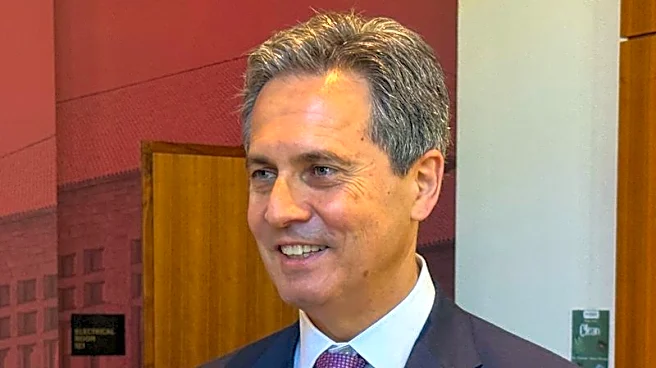
St. Louis Federal Reserve President Alberto Musalem has indicated that the Federal Reserve may need to implement several interest rate increases before spring 2027 to bring inflation under control. Musalem stated that the real policy rate, which is the Fed's
benchmark interest rate adjusted for inflation, should be between 2% and 2.5% by next spring. He estimates that the current rate is approximately a full percentage point below this target. This assessment suggests the possibility of rate hikes at upcoming Federal Open Market Committee (FOMC) meetings in December, January, March, and April. While acknowledging an unlikely scenario where no further hikes would be necessary, Musalem emphasized that the more probable outcome involves persistent strong demand and ongoing supply pressures keeping inflation above the Fed's 2% target, thus necessitating further increases from the current 3.75%-4% range.
Why It's Important?
Musalem's hawkish stance highlights the Federal Reserve's ongoing commitment to achieving its 2% inflation target, signaling potential continued tightening of monetary policy. Such a trajectory of multiple rate hikes could significantly impact various sectors of the U.S. economy. Businesses may face higher borrowing costs, potentially slowing investment and expansion plans. Consumers could experience increased costs for loans, mortgages, and credit, affecting purchasing power and discretionary spending. Industries sensitive to interest rates, such as housing and automotive, could see reduced demand. While the goal is price stability, the path to achieving it through aggressive rate increases carries the risk of dampening economic growth and potentially leading to a recession. Conversely, failure to control inflation could erode the value of savings and create economic uncertainty, making the Fed's actions critical for long-term economic health.
What's Next?
The Federal Reserve's upcoming FOMC meetings in December, January, March, and April will be closely watched for any indications of rate hikes, as suggested by President Musalem. While Musalem does not have a vote on the FOMC during this period, his views contribute to the broader discussion and the 'dot plot' of members' expectations. Market participants will be analyzing economic data, including inflation reports, employment figures, and consumer spending, to gauge the likelihood and magnitude of future rate adjustments. Businesses and consumers should prepare for a potentially sustained period of higher interest rates, which could influence financial planning, investment decisions, and borrowing strategies. The Fed's communication regarding its economic outlook and policy intentions will be crucial in shaping market expectations and economic behavior in the coming months.
Beyond the Headlines
The discussion around multiple interest rate hikes extends beyond immediate economic indicators, touching upon the delicate balance between controlling inflation and fostering economic growth. The Fed's approach reflects a broader challenge in managing an economy characterized by both strong demand and supply-side constraints. The potential for a higher real policy rate, whether driven by lower inflation or a higher nominal policy rate, underscores the complexity of monetary policy in the current environment. This situation also highlights the differing perspectives within the Federal Reserve system, as policymakers weigh various economic models and real-world observations. The long-term implications could include a recalibration of investment strategies, a shift in consumer spending habits, and a re-evaluation of risk in financial markets as the economy adjusts to a potentially prolonged period of tighter monetary conditions.