







What's Happening?
Tata Motors Limited, a global automobile manufacturer, has undergone significant corporate restructuring and amalgamations. Initially incorporated as Tata Motors Commercial Vehicles Limited on June 23, 2024, the company officially changed its name to Tata Motors Limited on October
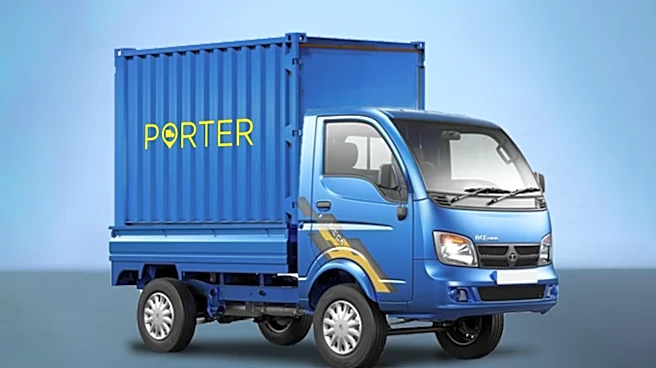
29, 2025. This change followed a Composite Scheme of Arrangement in FY 2025, which demerged the Commercial Vehicle (CV) Business from the Passenger Vehicles Business into a new entity, Tata Motors Commercial Vehicles Ltd. (TMLCV), effective July 1, 2025. The scheme became fully effective on October 1, 2025, leading to the issuance of 3,68,23,31,373 equity shares. The company's core business involves the design, development, manufacturing, and distribution of commercial vehicles, including SCVs, Pickups, Medium and Heavy Commercial Vehicles, Intermediate and Light Commercial Vehicles, and CV Passenger Vehicles under the Tata and Daewoo brands. Additionally, in FY 2025-26, TMF Holdings Limited and TMF Business Services Limited were amalgamated with Tata Motors Limited, and the company accepted the transfer of outstanding Non-Convertible Debentures totaling Rs 2300 crore from Tata Motors Passenger Vehicles Limited.
Why It's Important?
This extensive corporate restructuring by Tata Motors is important as it strategically separates its commercial and passenger vehicle businesses, aiming to enhance focus and operational efficiency within each segment. The demerger allows the commercial vehicle division to concentrate on its specific market needs, product development, and distribution networks, potentially leading to more agile decision-making and improved performance. The amalgamation of TMF Holdings Limited and TMF Business Services Limited, along with the transfer of significant debentures, streamlines the company's financial structure and consolidates its assets and liabilities. This move could strengthen Tata Motors' financial position and provide greater clarity for investors regarding the performance of its distinct business units. For the U.S. market, while Tata Motors primarily operates in India and Southern Asia, such internal reorganizations can influence its global competitiveness and potential for future international expansion or partnerships, particularly in the commercial vehicle sector.
What's Next?
Following these corporate changes, Tata Motors is expected to continue its focus on expanding its commercial vehicle offerings and associated services, spare parts, and digital businesses. The company's acquisition of a 26% stake in Traveltime E-Mobility Chennai Private Limited (TECPL) in January 2026, making TECPL an associate, indicates a strategic move into e-mobility solutions within the commercial sector. The incorporation of AIEQU Mobility Limited as a wholly-owned subsidiary in January 2026 further underscores this direction. These developments suggest a future emphasis on electric mobility and advanced automotive technologies within its commercial vehicle portfolio. Investors and market observers will likely monitor the performance of the newly structured commercial vehicle entity and its ventures into e-mobility for indications of future growth and market leadership in the evolving automotive landscape.
Beyond the Headlines
The corporate maneuvers by Tata Motors reflect a broader trend in the automotive industry towards specialization and the pursuit of electric mobility. By demerging its commercial and passenger vehicle businesses, Tata Motors is positioning itself to better adapt to the distinct challenges and opportunities in each segment. The significant investment in e-mobility through acquisitions and new subsidiaries highlights the company's commitment to sustainable transportation and its anticipation of future market demands. This strategic shift could have long-term implications for the automotive supply chain, technological innovation, and environmental standards, potentially influencing global industry practices. The consolidation of financial entities also suggests a move towards greater corporate governance and financial transparency, which can enhance investor confidence and attract further capital for future growth initiatives.