




What's Happening?
The U.S. stock market is experiencing a significant and rapid divergence between value and growth stocks, a phenomenon not seen since the dot-com bubble burst in 2001. Over the seven weeks leading up to November 20, the iShares Russell 1000 Value Index
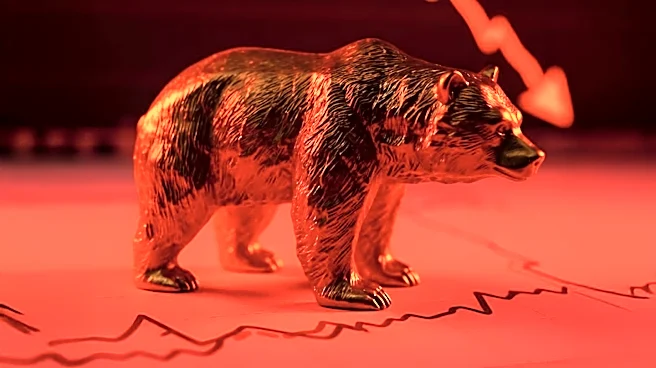
Fund saw a marginal slip of 0.8%, while the iShares Russell 1000 Growth Fund plummeted by 20%. This has resulted in a 23.9% jump in the ratio between the two funds, marking the largest seven-week swing towards value since March 5, 2001, when the ratio reached 26.1%. This current market movement is characterized as a 'growth collapse' rather than a value rally, with mega-cap technology stocks experiencing their worst de-rating in 17 years. The S&P 500 has entered a correction, and the Philadelphia Semiconductor Index, Nasdaq 100, and Russell 1000 Growth index are already in bear markets. Nvidia Corp., a leader in the AI rally, has seen its stock fall 47.5% from its October 6 record high.
Why It's Important?
This historic divergence signals potential instability within the U.S. equity markets, particularly for technology and growth-oriented sectors. The rapid decline in growth stocks, reminiscent of the early 2000s, raises concerns about the sustainability of recent market rallies, especially those driven by artificial intelligence. Investors are facing a critical juncture, with Wall Street analysts divided on whether this trend indicates a turning cycle or a temporary correction. The underperformance of growth stocks could lead to a broader market re-evaluation, potentially shifting investment strategies towards more stable, value-oriented companies. This situation also highlights the vulnerability of highly concentrated portfolios in specific sectors, as exemplified by Nvidia's significant drop. The Federal Reserve's hawkish stance on inflation further complicates the outlook, suggesting that economic growth may slow while monetary policy remains tight, adding pressure to market performance.
What's Next?
Market participants will closely monitor whether the current trend of value outperforming growth will persist or if growth stocks will see a rebound. The historical parallel to 2001 suggests that any immediate recovery in growth stocks might be short-lived, as the previous bounce in 2001 ultimately led to further declines. Analysts are divided, with some bears predicting a continued cycle turn and others arguing that much of the damage to growth stocks has already occurred. Investors may increasingly seek shelter in value stocks, although the 2001 precedent shows that even value offered limited safety during prolonged downturns. The performance of key technology indicators like the Nasdaq 100 and the Philadelphia Semiconductor Index will be crucial in determining the market's direction. The Federal Reserve's future monetary policy decisions will also play a significant role in shaping market sentiment and the relative performance of different equity segments.
Beyond the Headlines
The current market dynamics could signify a fundamental re-evaluation of investment paradigms that have favored growth stocks for an extended period. This shift might reflect a broader economic sentiment where investors prioritize tangible assets, stable earnings, and lower valuations over speculative growth potential, especially in a high-interest-rate environment. The decline in mega-cap tech stocks could also signal a maturing of the AI investment cycle, prompting a more discerning approach to technology valuations. This could lead to a reallocation of capital across industries, potentially benefiting traditional sectors that have been overlooked during the tech boom. Furthermore, the situation might prompt a re-examination of portfolio diversification strategies, emphasizing the importance of balancing growth and value exposures to mitigate risk in volatile market conditions. The long-term implications could include a more balanced market leadership, moving away from the concentrated dominance of a few technology giants.