







What's Happening?
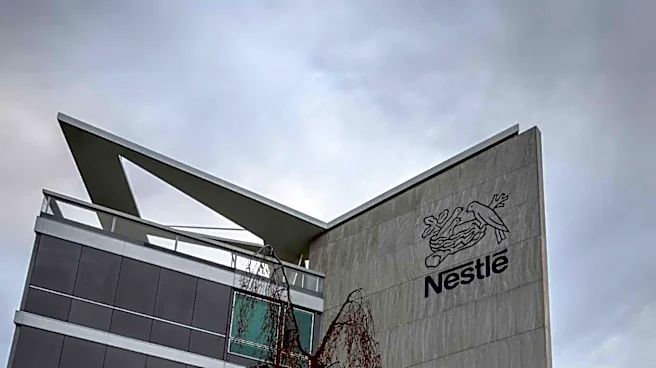
Nestlé has announced a four percent organic sales growth for the third quarter of the year, reaching a total reported sales figure of CHF 22.8 billion. This growth comes after the company's complete exit from its Russian business, which was finalized
in September 2026. According to Nestlé, the divestment of its Russian operations had no impact on the Q3 sales figures or the nine-month chart, and only a limited financial effect on underlying numbers. Nestlé CEO Philipp Navratil emphasized the company's strategy to concentrate its portfolio on its 'strongest advantages.' The Americas region was highlighted as the strongest market, with sales of CHF 28.7 billion, while the Asia, Oceania, and Africa markets collectively achieved the highest organic growth at five percent. The pet care and food & snacks categories were key drivers of this global performance, showing an organic growth of 5.3 percent in the quarter.
Why It's Important?
Nestlé's ability to maintain robust organic sales growth despite exiting a significant market like Russia demonstrates the resilience and strategic adaptability of large multinational corporations. This performance indicates that the company's diversified global presence and focus on core strengths can offset the impact of geopolitical shifts and market withdrawals. For U.S. consumers and investors, Nestlé's continued growth signifies stability in the food and beverage sector, which is often seen as a defensive industry during economic uncertainties. The strong performance in the Americas zone underscores the importance of the U.S. market to Nestlé's overall success and could lead to further investment and product development tailored for this region. The emphasis on 'strongest advantages' suggests a strategic streamlining of its product offerings, which could lead to increased efficiency and profitability, benefiting shareholders and potentially influencing competitive strategies within the U.S. food industry.
What's Next?
Nestlé anticipates continued positive momentum, projecting an organic growth for the full year to be between three and four percent. The company also expects to report an improved underlying trading operating profit margin compared to 2025, along with a free cash flow exceeding CHF 9 billion. This outlook suggests a sustained focus on operational efficiency and strategic portfolio management. Future actions may include further divestments of non-core assets, as indicated by the agreement to divest its mainstream vitamins, minerals, and supplements business, to further concentrate on areas of competitive advantage. Investors and market analysts will be closely watching for how Nestlé continues to execute its strategy of focusing on high-growth and high-margin segments, particularly in key markets like the U.S. The company's performance will also serve as a benchmark for other multinational corporations navigating complex global market conditions and geopolitical pressures.
Beyond the Headlines
Nestlé's successful navigation of its exit from Russia while maintaining growth highlights a broader trend among global corporations: the increasing need for agility and strategic portfolio optimization in response to geopolitical instability. This situation underscores the ethical and business complexities companies face when operating in politically sensitive regions. The decision to exit Russia, while having a limited financial impact on reported sales, reflects a significant corporate decision with long-term implications for brand reputation and market positioning. Furthermore, Nestlé's focus on 'strongest advantages' could signal a shift towards more specialized product lines and away from broad market saturation, potentially influencing consumer choices and market trends in the U.S. The company's ability to thrive post-divestment also provides a case study for other businesses contemplating similar strategic realignments in response to evolving global landscapes.