


What's Happening?
Goldman Sachs has adjusted its end-2027 gold price forecast, lowering it from $4,800 to $4,650 per ounce. Despite this revision, the new forecast still represents a 21% increase from current levels. The investment bank anticipates that gold will recover
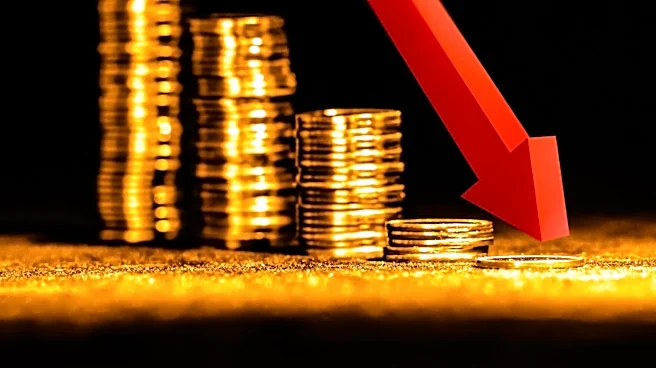
its New Year's peak of $5,600 per ounce in 2028. This recovery is projected to occur once the Federal Reserve begins cutting interest rates, which Goldman Sachs believes will help stimulate demand for Western Exchange Traded Funds (ETFs) and support a stronger gold rally. Currently, gold prices are experiencing volatility, with a recent drop to $3,840 before rising to $3,870, marking one of the worst 12-week gold price declines in the past two decades. This comes as the U.S. Dollar has reached its highest in 20 months, driven by expectations of multiple Federal Reserve interest rate hikes.
Why It's Important?
Goldman Sachs' revised forecast is significant for U.S. investors and the broader financial market, as it signals a potential shift in the outlook for precious metals amidst evolving monetary policy. The expectation of Federal Reserve rate cuts in 2028 as a catalyst for gold's recovery highlights the strong correlation between interest rates and gold's appeal as a non-yielding asset. Higher interest rates typically make gold less attractive compared to interest-bearing investments, while lower rates tend to boost its demand. This forecast provides a long-term perspective for investors, suggesting that despite current volatility and a strong dollar, gold retains its potential as a valuable asset. The anticipated recovery in Western ETF demand underscores the importance of institutional investment flows in driving gold prices, impacting investment strategies for both individual and institutional players in the U.S.
What's Next?
The immediate future for gold prices will likely remain influenced by expectations surrounding the Federal Reserve's interest rate decisions. As the market anticipates potential rate hikes, gold may continue to face headwinds. However, the long-term outlook, as projected by Goldman Sachs, points towards a recovery in 2028, contingent on the Fed's policy shift towards rate cuts. This suggests that investors might need to adopt a patient approach, monitoring economic indicators and central bank communications closely. The forecast also implies that demand for gold ETFs, particularly in Western markets, will be a key factor in the metal's future performance. Market participants will be watching for signs of a dovish pivot from the Federal Reserve, which could trigger the anticipated rally in gold prices.
Beyond the Headlines
Beyond the immediate price movements, Goldman Sachs' forecast reflects a broader narrative about the interplay between monetary policy, investor sentiment, and safe-haven assets. The emphasis on the Federal Reserve's actions underscores the central bank's immense influence on global financial markets and commodity prices. This situation also highlights the ongoing debate about gold's role as an inflation hedge versus a safe haven during economic uncertainty. The current market dynamics, with a strong dollar and rising interest rate expectations, challenge gold's traditional appeal, but the long-term recovery forecast suggests an underlying confidence in its intrinsic value. This could lead to a re-evaluation of investment strategies, with a greater focus on long-term economic cycles and central bank policies rather than short-term market fluctuations.