



What's Happening?
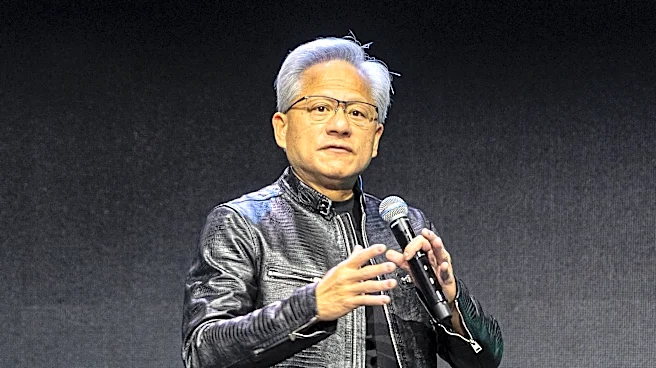
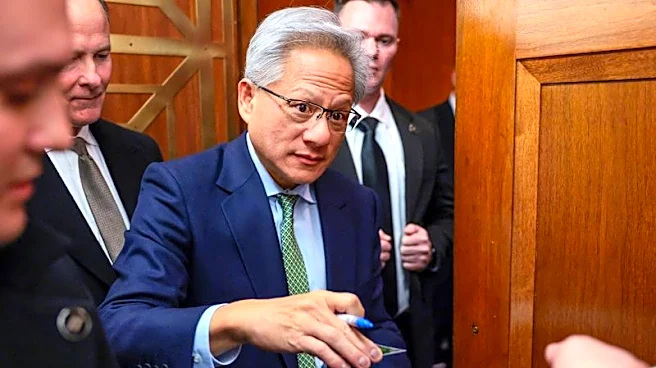
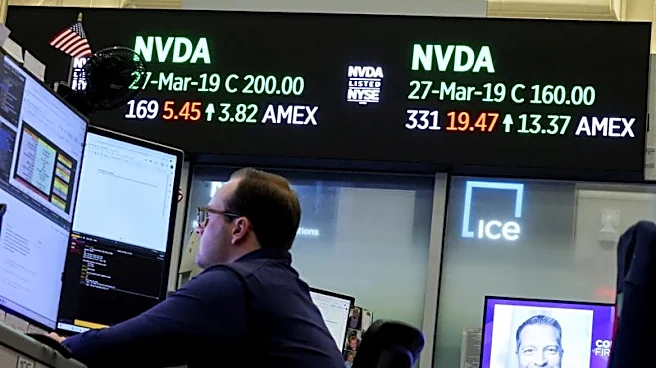
Jensen Huang has reportedly returned to his position as CEO of Nvidia. This development follows input received by Nvidia's board from "senior levels" of the U.S. government. The return of Huang to the helm of the company has prompted discussions regarding
the involvement of President Trump and JD Vance, as well as the potential implications for the stock market. Separately, Levent Alpöge, a mathematician at Anthropic, claims that he and the AI model Claude have successfully proven the Riemann hypothesis, a mathematical problem that has remained unsolved since 1859. This claim has generated significant reaction within the mathematical community and raises questions about the accelerating progress of AI in various domains. The news was discussed by Machine Gods co-hosts Kevin Roose and Casey Newton.
Why It's Important?
The return of Jensen Huang to Nvidia, reportedly influenced by senior U.S. government officials, underscores the strategic importance of technology companies like Nvidia to national interests, particularly in the context of artificial intelligence and semiconductor development. Government involvement in corporate leadership decisions, especially concerning a major tech player, could set a precedent for future interventions in industries deemed critical for national security or economic competitiveness. For the stock market, such interventions can introduce volatility and uncertainty, as investors weigh the implications of political influence on corporate governance and market dynamics. The claim of AI solving the Riemann hypothesis, if validated, would represent a monumental leap in AI capabilities, potentially revolutionizing scientific research and problem-solving across numerous fields. This could accelerate the adoption of AI in complex domains, impacting industries from finance to healthcare by offering unprecedented analytical power.
What's Next?
The immediate focus will likely be on the official confirmation and details surrounding Jensen Huang's return to Nvidia, including any public statements from the company or government officials clarifying the nature of the "input" received by the board. Market analysts will closely monitor Nvidia's stock performance and strategic direction under Huang's renewed leadership, particularly concerning its role in the AI and semiconductor sectors. For the Riemann hypothesis claim, the mathematical community will undertake rigorous peer review and verification processes. If the proof by Levent Alpöge and Claude is substantiated, it could lead to a re-evaluation of AI's potential in fundamental scientific discovery and prompt increased investment in AI research for complex problem-solving. Discussions will also likely emerge regarding the ethical and practical implications of AI-driven scientific breakthroughs.
Beyond the Headlines
The reported government influence in Nvidia's leadership succession highlights a growing trend of national governments asserting greater control or influence over critical technology sectors. This could signify a shift towards a more interventionist industrial policy in the U.S., driven by geopolitical competition and the strategic importance of AI and advanced computing. Such interventions raise questions about the balance between free-market principles and national security imperatives, potentially leading to debates about corporate autonomy and government oversight in key industries. The alleged AI solution to the Riemann hypothesis, if true, transcends a mere mathematical achievement; it would challenge long-held assumptions about human intellect's unique capacity for abstract reasoning and discovery. This could spark profound philosophical and societal discussions about the role of AI in advancing human knowledge, potentially leading to new paradigms in education, research, and the very definition of intelligence.