







What's Happening?
Despite significant efficiency improvements in AI chips, data center power demand continues to explode, illustrating a 'Jevons paradox' effect. Newer AI chips, such as Nvidia's Vera Rubin platform, offer up to 10 times more inference performance per watt
than previous generations. However, the power consumed by state-of-the-art server racks has dramatically increased. A Hopper rack in 2023 consumed approximately 40 kW, while a Vera Rubin NVL72 in 2024 requires around 210 kW. Projected 'Rubin Ultra' (Kyber) racks due in 2027 are expected to draw 600 kW, with 1 MW+ units already in development. This represents a 15-fold increase in power draw over just four years, even with a 10-fold leap in watt efficiency. The increased efficiency allows engineers to pack more compute into each rack, leading hyperscalers to deploy this capability to serve ever-larger models and workloads. Consequently, cooling has become a critical infrastructure requirement, with a shift towards warm-water direct-to-chip liquid cooling, and the liquid cooling market for data centers is predicted to exceed $7 billion by 2029.
Why It's Important?
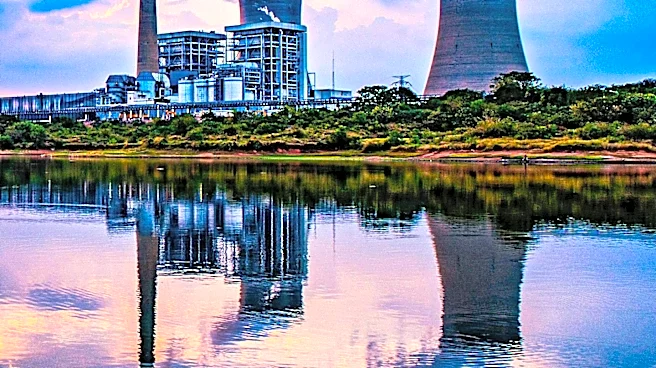
This phenomenon has profound implications for the U.S. energy grid, infrastructure development, and the sustainability of the AI industry. The escalating power demands of data centers, driven by increasingly efficient yet more powerful AI chips, create immense pressure on existing energy supplies and necessitate significant investments in new power generation and distribution. Hyperscalers are actively securing gigawatt-scale energy contracts and investing in nuclear and fusion power projects, indicating that traditional energy sources may not suffice. This surge in demand could lead to higher energy costs for businesses and consumers, and potentially strain grid reliability. The shift to advanced cooling technologies also represents a substantial new market opportunity for specialized engineering and manufacturing firms. Ultimately, the 'Jevons paradox' in AI compute means that technological efficiency alone will not curb energy consumption; instead, it fuels an insatiable demand for more compute, making energy supply the primary bottleneck for AI growth.
What's Next?
The immediate future will see continued aggressive investment by hyperscalers in securing diverse energy sources, including nuclear and potentially fusion power, to meet their escalating demands. Construction of new power plants and upgrades to existing grid infrastructure will be critical. The liquid cooling market is set for substantial growth, with Dell'Oro predicting it will exceed $7 billion by 2029, indicating a boom for companies specializing in these solutions. Infrastructure developers will need to factor in significantly higher electrical and cooling budgets for future data center builds. Policy discussions around energy efficiency, renewable energy integration, and grid modernization will become increasingly urgent. The long-term trajectory of AI development will be heavily influenced by the ability to provide sustainable and scalable power solutions, potentially leading to innovations in energy storage and localized power generation for data centers.
Beyond the Headlines
The exploding power demand of AI data centers raises significant ethical and environmental questions. The pursuit of ever-larger AI models and workloads, while driving technological advancement, comes at a substantial environmental cost in terms of energy consumption and carbon footprint. This could lead to increased public scrutiny and calls for greater transparency and accountability from tech companies regarding their energy usage. Furthermore, the concentration of AI compute power in the hands of a few hyperscalers, who are also investing heavily in their own energy infrastructure, could create new forms of market dominance and control over critical technological resources. The reliance on advanced cooling technologies also highlights the increasing complexity and specialization required to maintain these systems, potentially creating a skills gap in the workforce. The long-term sustainability of AI's growth will depend not just on chip innovation, but on a holistic approach to energy, infrastructure, and environmental stewardship.