





What's Happening?
New York Governor Hochul has announced a $10 million investment in workforce development programs aimed at supporting the state's advanced, emissions-free nuclear energy initiatives. This funding, drawn from the Power Authority, is part of Governor Hochul's
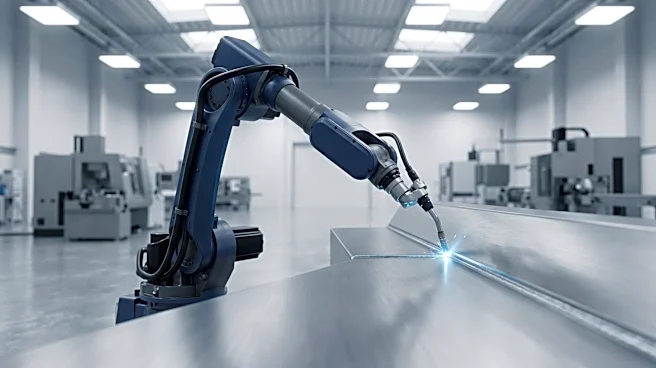
NextGen Nuclear New York program, which seeks to cultivate a skilled in-state nuclear workforce. The investment will support various educational and training pathways, including a three-course nuclear manufacturing micro-credential and a welder certification-based training program. These programs will integrate nuclear content into existing welding, mechatronics, and engineering curricula. Specific awards include $1.5 million to SUNY Syracuse Educational Opportunity Center for instrumentation and control training, welding, and civil/structural construction, and $1.06 million to Manufacturers Talent Institute for workforce development. The Power Authority's funding also covers career services, materials, and certification-related costs for participants.
Why It's Important?
This $10 million investment is crucial for New York's clean energy transition and economic development. By focusing on workforce development in the nuclear sector, the state is addressing a critical need for skilled labor to support its goal of developing at least 1 GW of advanced, emissions-free nuclear energy. This initiative will create new job opportunities and pathways for residents into high-demand technical fields, strengthening the state's manufacturing and energy sectors. The integration of nuclear content into existing vocational and engineering programs ensures a pipeline of talent equipped with specialized skills, which is vital for the successful deployment and operation of next-generation nuclear projects. Furthermore, by fostering an in-state nuclear workforce, New York aims to enhance its energy independence and reduce reliance on fossil fuels, contributing to broader climate goals and economic stability.
What's Next?
The newly funded programs will begin developing and implementing their specialized training curricula, focusing on areas like nuclear manufacturing, micro-credentialing, and welder certification. Educational institutions and training centers, such as SUNY Syracuse Educational Opportunity Center and Manufacturers Talent Institute, will start enrolling participants and providing hands-on training. The Power Authority will continue its efforts to develop a skilled in-state nuclear workforce through coordinated education and training pathways. This initiative is expected to contribute to the state's broader clean energy transition, with ongoing efforts to identify tools and approaches needed to responsibly advance next-generation nuclear power. The success of these programs will be measured by their ability to produce a qualified workforce capable of supporting New York's advanced nuclear energy projects, ultimately contributing to grid reliability and a growing clean energy economy.
Beyond the Headlines
This investment signifies a strategic shift towards recognizing nuclear energy as a vital component of a clean energy future, moving beyond traditional renewable sources. The focus on micro-credentials and certification-based training highlights an evolving approach to workforce education, emphasizing practical, job-specific skills over traditional degree programs. This model could serve as a blueprint for other states looking to build specialized workforces for emerging industries. Ethically, the initiative underscores the importance of ensuring equitable access to these new job opportunities, particularly for underserved communities, through comprehensive support services like childcare and transportation. Long-term, a robust in-state nuclear workforce could position New York as a leader in advanced nuclear technology, attracting further investment and innovation in the sector and potentially influencing national energy policy discussions.