






What's Happening?
Hedge fund manager Dan Loeb has estimated that the ongoing build-out of artificial intelligence (AI) infrastructure will necessitate an additional $2-3 trillion in annual revenue. This projection comes against a backdrop of approximately $6 trillion in current
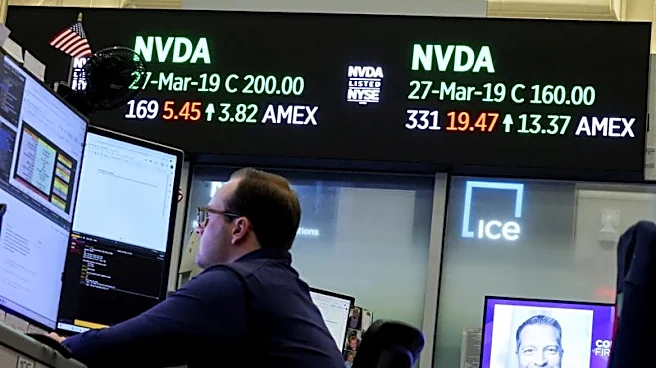
global IT spending. The S&P 500's forward price-to-earnings (P/E) ratio has decreased from 22x in January to around 16x, with consensus forecasts indicating a halving of earnings growth next year. Despite this, the market is grappling with the extent to which the AI investment cycle can continue to drive returns. Goldman Sachs, for instance, anticipates that AI spending growth will reach its peak in the first half of 2027. The current market environment has seen significant volatility, with the S&P 500 experiencing a nearly 12% drop from its October peak in just 33 trading days, and NVIDIA losing $2.7 trillion in market value over six weeks.
Why It's Important?
Dan Loeb's estimation of a multi-trillion-dollar AI build-out highlights the immense capital allocation and investment expected in the technology sector, which has significant implications for the U.S. economy and global markets. This substantial investment could fuel innovation and create new industries, but it also raises questions about the sustainability of AI-driven growth and market leadership. As the AI investment cycle matures, there may be a shift in investor focus from companies spending heavily on growth to those generating substantial cash flow and rewarding shareholders through mechanisms like share buybacks. This potential shift could redefine market leaders and investment strategies, impacting various sectors beyond technology. The current market volatility, characterized by rapid corrections and significant value losses in major tech companies, underscores the risks and opportunities associated with this evolving landscape.
What's Next?
As the AI investment cycle progresses, the market is expected to increasingly scrutinize companies' ability to generate cash and return capital to shareholders, rather than solely focusing on growth spending. This could lead to a re-evaluation of investment strategies, with a potential shift towards businesses with strong free cash flow, sensible valuations, and disciplined buybacks. Companies like Alphabet and Meta, which were once prominent in share repurchases, are now issuing shares to fund their AI ambitions, indicating a temporary shift in capital allocation priorities. However, they may resume buybacks once AI spending peaks and cash flows stabilize. The broader economic calendar includes key indicators such as flash PMIs, October core PCE, and the Beige Book, which will offer further insights into the real economy and potential Federal Reserve policy decisions, particularly concerning interest rate hikes.
Beyond the Headlines
The massive projected investment in AI, as estimated by Dan Loeb, points to a fundamental transformation of the technological and economic landscape. This shift could lead to ethical and societal debates regarding job displacement, data privacy, and the concentration of power among AI-dominant corporations. The emphasis on cash generation and shareholder returns in a maturing AI market also highlights a potential long-term shift in corporate governance and investment philosophy, moving away from a 'growth at all costs' mentality. This could trigger a re-evaluation of traditional valuation metrics and encourage a more disciplined approach to capital allocation. The rapid market corrections observed in the S&P 500 and the significant value loss in companies like NVIDIA suggest that while AI offers immense potential, it also carries inherent risks and uncertainties that could reshape market dynamics for years to come.