







What's Happening?
IQM Quantum Computers and Zurich Instruments have announced a joint project to develop and operate a real-time quantum error correction (QEC) demonstrator. This initiative is powered by the NVIDIA NVQLink platform and represents a significant step towards
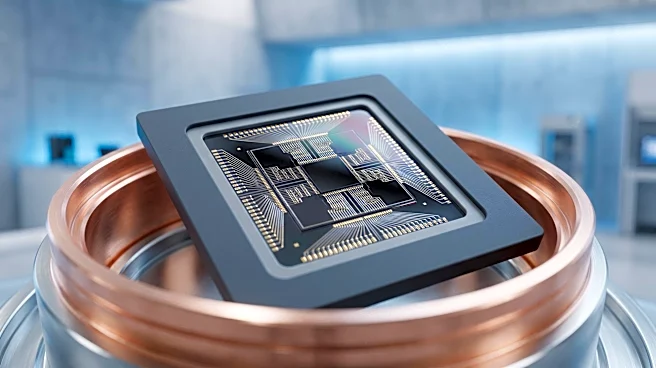
scalable and fault-tolerant quantum computing for enterprise and datacenter deployment. The project aims to address the challenges of reliably operating quantum computers and integrating them into existing supercomputing infrastructure. The demonstrator combines IQM’s 20-qubit superconducting quantum computer with Zurich Instruments’ new ZQCS Quantum Control System and GPU-accelerated classical computing enabled by NVQLink. This integrated system is designed to support closed-loop, low-latency decoding and feedback, which are crucial capabilities for operating logical qubits at scale and achieving fault-tolerant quantum computing. According to Tim Costa, Vice President and General Manager for Quantum at NVIDIA, this collaboration demonstrates the possibility of low-latency, high-throughput integrations between quantum processors and accelerated computing.
Why It's Important?
This collaboration is important because it directly addresses critical barriers to the widespread adoption and practical application of quantum computing. As enterprises and public institutions move beyond initial quantum exploration, the focus shifts to operational reliability, seamless integration, and scalability towards fault tolerance. The development of a real-time QEC demonstrator is a crucial step in this direction, as quantum error correction is essential for mitigating the inherent instability and errors in quantum systems. By aligning quantum hardware, control electronics, and classical acceleration within a single operational architecture, the project establishes a practical foundation for future NVQLink-based products. This integration is vital for enabling quantum computers to function reliably within modern datacenter environments, potentially unlocking new computational capabilities for complex problems that are currently intractable for classical supercomputers. The success of this demonstrator could accelerate the transition of quantum computing from theoretical research to practical, industrial-grade applications.
What's Next?
The immediate next step is the continued development and operation of the real-time quantum error correction demonstrator. The project aims to refine the integration of IQM’s quantum computer, Zurich Instruments’ control system, and NVIDIA’s NVQLink platform to enhance its capabilities for closed-loop, low-latency decoding and feedback. This will involve rigorous testing and optimization to ensure the reliable operation of logical qubits at scale. The insights gained from this demonstrator are expected to inform the development of future NVQLink-based products, paving a clear path toward scalable and fault-tolerant quantum computers. The long-term vision is to enable the widespread distribution and routine use of quantum computing, making fault-tolerant quantum systems accessible and impactful for organizations globally. This project is a foundational step in building the necessary infrastructure for a future where quantum computing is a standard tool in the computational landscape.
Beyond the Headlines
Beyond the immediate technical advancements, this project signifies a broader trend of convergence between quantum processors and classical supercomputing infrastructure. This convergence is critical for expanding the scope of problems that can be tackled with advanced computing. The emphasis on 'quantum-centric supercomputing' suggests a future where quantum and classical systems work in tandem, each leveraging its strengths to solve highly complex computational challenges. The ethical and societal implications of fault-tolerant quantum computing are profound, potentially impacting fields such as drug discovery, materials science, financial modeling, and artificial intelligence. As quantum systems become more robust and integrated, questions around data security, algorithmic bias, and the equitable distribution of this powerful technology will become increasingly pertinent. This initiative is not just about building a better computer; it's about laying the groundwork for a new era of computational capability that will reshape industries and scientific research.