



What's Happening?
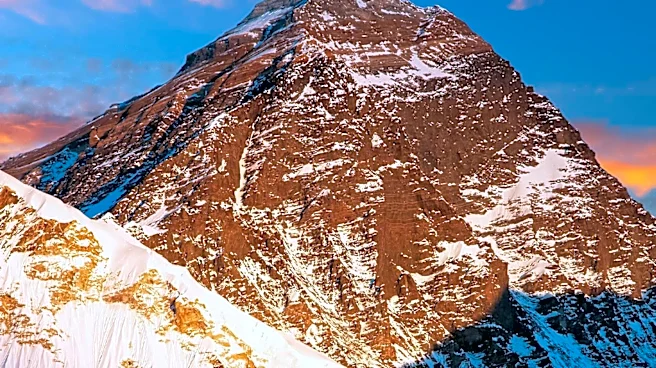
The documentary 'Everest: The Other Side,' directed by Elizabeth Chai Vasarhelyi and Jimmy Chin, is reviewed as a film that raises ethical questions about extreme sports and the pursuit of perilous feats. The film chronicles climber Jim Morrison's attempt
to ski down Mount Everest, a dream he shared with his late partner Hilaree Nelson, who died during a separate skiing incident in Nepal. The review notes that while the film aims for the exhilaration seen in the directors' previous work, 'Free Solo,' it struggles with the tragic backstory of Nelson's death. The documentary is criticized for weakly addressing the inherent risks and for presenting Nelson's death as a 'twist' to uninformed viewers. Despite the tragedy, the film largely celebrates determination and the completion of Morrison's quest, with the filmmakers, who were close friends of the couple, seemingly overlooking deeper introspection about the risks involved.
Why It's Important?
This review is important because it critiques the ethical responsibilities of documentary filmmaking, especially when dealing with high-risk activities and personal tragedy. It highlights the tension between celebrating human achievement in extreme sports and acknowledging the profound dangers and consequences, including loss of life. The film's approach, which is seen as downplaying the ethical questions and the impact of Nelson's death, raises concerns about how such stories are framed for public consumption. This can influence public perception of risk, heroism, and the value placed on human life versus extreme accomplishments. For the documentary genre, it underscores the need for sensitivity, thoroughness, and a balanced perspective, particularly when the subjects are friends of the filmmakers and when a tragic event is central to the narrative. It also prompts viewers to critically evaluate the motivations behind such endeavors and their portrayal.
What's Next?
The review suggests that viewers of 'Everest: The Other Side' will be left to ponder the broader implications of extreme sports and the filmmakers' narrative choices. The film's release will likely continue to spark discussions among critics and audiences about the ethics of documenting dangerous pursuits and the responsibility of filmmakers to address the full scope of consequences, including tragedy. It may also influence future documentary projects in the extreme sports genre, encouraging a more introspective and ethically conscious approach to storytelling. The critical reception could prompt the directors, Vasarhelyi and Chin, to reflect on their narrative strategies and the balance between awe-inspiring visuals and profound human cost in their future works. The film's impact will extend to how the public perceives the inherent risks and the often-unseen sacrifices made in the pursuit of extreme athletic achievements.
Beyond the Headlines
The film's narrative, particularly its handling of Hilaree Nelson's death, touches upon deeper cultural and psychological aspects of risk-taking and the human drive for conquest. The 'because it's there' mentality, attributed to early Everest climbers, is juxtaposed with the modern context of extreme sports, where personal ambition and public spectacle often intertwine. The review implicitly questions the societal glorification of such dangerous endeavors, especially when they lead to tragic outcomes and leave behind families. The filmmakers' close relationship with the subjects adds another layer of complexity, raising questions about objectivity and the potential for personal bias to shape the narrative. This situation highlights the ongoing debate about the line between inspiring adventure and reckless endangerment, and how media representation can either reinforce or challenge these perceptions, ultimately influencing cultural values around risk, achievement, and the sanctity of life.