









What's Happening?
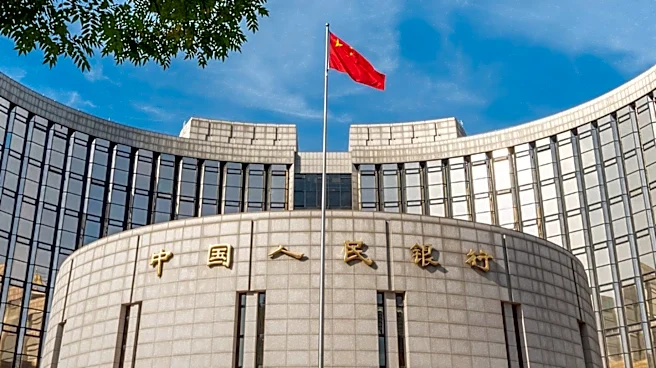
The People's Bank of China (PBOC) is considering a significant shift in its monetary policy framework, potentially moving its predominant open-market operations from a seven-day to an overnight policy rate. PBOC Governor Pan Gongsheng indicated that the
interbank overnight repo rate, DR001, already functions as its monetary policy target, and this change would align policy operations more closely with market rates. Additionally, the PBOC plans to diversify loan pricing benchmarks, allowing financially strong enterprises to choose between the overnight repo rate and the loan prime rate (LPR) for negotiated floating-rate loans. In a move to enhance financial stability, the PBOC, National Financial Regulatory Administration, and China Securities Regulatory Commission (CSRC) will establish a contingent liquidity facility for asset managers facing market-wide stress. This facility aims to curb bond sell-offs driven by fund redemptions by providing collateral-backed funding to eligible institutions, including bank wealth management subsidiaries and public fund managers. The PBOC also announced plans to broaden access to its standing lending facility (SLF) to include locally incorporated foreign banks.
Why It's Important?
These proposed changes by the PBOC are significant for China's financial markets and broader economy. Shifting to an overnight policy rate could enhance the central bank's precision in managing short-term liquidity and interest rates, making monetary policy transmission more direct and efficient. Diversifying loan pricing benchmarks offers greater flexibility for corporate borrowers and could lead to more market-driven loan rates, impacting corporate financing costs and bank profitability. The establishment of a liquidity backstop for asset managers is crucial for mitigating systemic risks, particularly in the bond market, which has shown vulnerabilities to redemption-driven sell-offs. This measure aims to prevent financial contagion and maintain market stability, thereby safeguarding investor confidence. Broadening SLF access to foreign banks signifies a move towards greater integration and equal treatment within China's financial system, potentially encouraging more foreign participation and competition in the banking sector. These reforms collectively aim to modernize China's financial infrastructure and enhance its resilience against market shocks.
What's Next?
The PBOC will study the feasibility and timing of shifting to an overnight policy rate, with operational details to follow. The contingent liquidity facility for asset managers will be established, with specific operating details to be announced in open-market communications. This will involve defining eligibility criteria, collateral requirements, and macroprudential conditions. The expansion of SLF access to locally incorporated foreign banks will proceed, integrating them into the same short-term funding framework as domestic lenders. Furthermore, China's first 18 actively managed ETFs are scheduled to begin fundraising, marking a new development in the asset management sector. The PBOC also plans to launch connectivity between China’s interbank and exchange bond markets after infrastructure providers and participants complete test runs, which could reduce operational barriers and improve liquidity flow between venues. These initiatives indicate a continuous effort by Chinese financial regulators to refine monetary policy tools, strengthen financial stability mechanisms, and deepen market integration.
Beyond the Headlines
These reforms reflect China's ongoing efforts to liberalize and internationalize its financial markets while maintaining stringent control over systemic risks. The move towards a more market-oriented interest rate framework, coupled with enhanced liquidity provisions, suggests a maturing financial system that is increasingly aligning with global best practices. The inclusion of foreign banks in key liquidity facilities underscores a strategic push to open up China's financial sector further, potentially attracting more foreign capital and expertise. However, these changes also present challenges, such as managing the transition to new policy rate benchmarks and ensuring that the liquidity backstop does not create moral hazard. The emphasis on financial stability and risk management, particularly in the asset management sector, highlights the authorities' cautious approach to reform, balancing market efficiency with systemic resilience. These developments could also influence the global financial landscape, as China's financial reforms have broader implications for international capital flows and the role of the Renminbi.