






What's Happening?
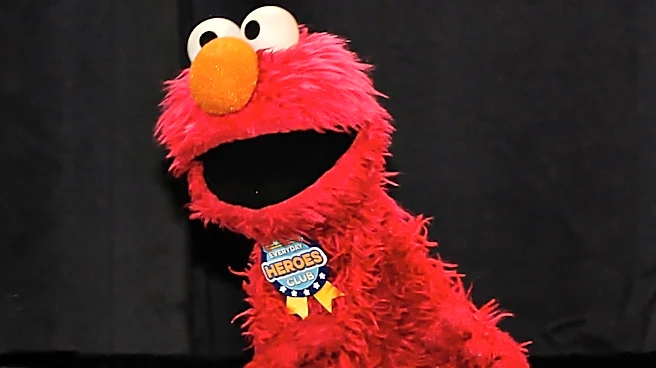
Elmo, the beloved three-and-a-half-year-old monster from Sesame Street, has adopted the persona of Miranda Priestly, Meryl Streep's character from 'The Devil Wears Prada,' for Halloween. In a video released by Sesame Street, Elmo is seen wearing a white
wig, glasses, and a black blazer over a white collared shirt, mimicking Priestly's appearance and famously dismissive attitude. He delivers sarcastic remarks, such as 'Pumpkins. For fall. How groundbreaking,' and critiques Cookie Monster's blue fur. This costume choice is noted as unusual for a character typically aimed at preschoolers, as the reference is primarily recognizable to adults familiar with the 2006 film. The decision has led to discussions about whether the Halloween sketch is primarily for Elmo's young audience or for adult viewers, and has drawn comparisons to past criticisms of Sesame Street's social messaging.
Why It's Important?
Elmo's Halloween costume choice highlights a growing trend in children's media to incorporate adult-oriented humor and references, often aimed at parents and older viewers. While this can broaden appeal, it also raises questions about the primary audience and the potential impact on young children who may not understand the context. For a character like Elmo, known for his enthusiasm and friendliness, adopting a sarcastic and condescending persona, even in jest, could be confusing for preschoolers. This move by Sesame Street, a long-standing educational program, reflects a balancing act between maintaining relevance with contemporary adult audiences and staying true to its core mission of educating and entertaining young children. The discussion also touches on broader societal conversations about gender roles and representation, as some online reactions have interpreted Elmo's 'Meryl drag' in various ways, including as a form of 'drag' or a 'Yas Queen' moment.
What's Next?
The reaction to Elmo's Halloween costume may influence future content decisions by Sesame Street and other children's programming. If the adult-oriented humor proves popular and generates significant engagement, similar content might be produced. Conversely, if the criticism regarding its appropriateness for young children gains traction, creators might re-evaluate their approach to incorporating adult references. This event could also spark further debate among parents, educators, and media critics about the evolving nature of children's entertainment and the balance between appealing to different age groups. The ongoing scrutiny of Sesame Street's social messaging suggests that any future creative choices that deviate from traditional norms will likely be met with similar public discussion and analysis.
Beyond the Headlines
Elmo's portrayal of Miranda Priestly delves into deeper cultural implications regarding the blurring lines between children's and adult entertainment, and the role of satire in media. The choice to have a preschool character embody a sophisticated, intimidating fashion editor can be seen as a commentary on celebrity culture and the pervasive influence of pop culture references across demographics. It also raises questions about the subtle ways in which children are exposed to adult themes and behaviors through media. The varied online reactions, from humor to critical analysis, underscore the diverse interpretations of such content and the ongoing dialogue about what constitutes appropriate and effective children's programming. This incident serves as a microcosm of the larger challenge faced by media creators in navigating a complex cultural landscape where content is consumed by multi-generational audiences with differing expectations and sensitivities.