







What's Happening?
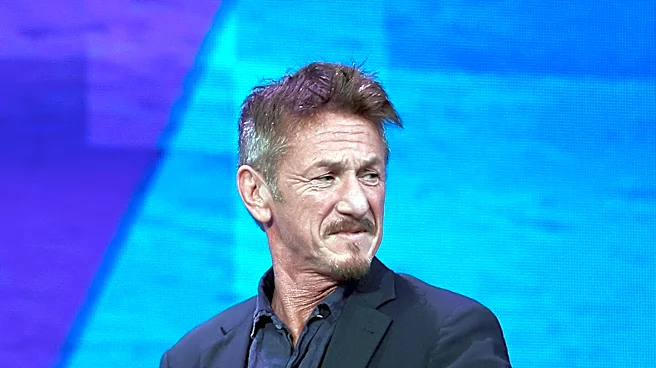
Sean Penn's 1984 film 'Racing With the Moon,' co-starring Nicolas Cage, underperformed at the box office, a situation some attributed to Penn's refusal to participate in promotional activities. Penn, known for his complex relationship with the press and
his activism, publicly stated that he finds such ceremonies and publicity anxiety-inducing. He later reflected on the film's performance, suggesting that the studio, Paramount Pictures, did not adequately support it, and he took some responsibility, saying, 'I’m the one that fucked it up, right, ’cause I didn’t do interviews.' Despite this, Penn's career rebounded quickly with 'The Falcon and the Snowman' the following year, which was critically acclaimed and performed better commercially. His career continued to flourish, leading to multiple Academy Awards in subsequent decades.
Why It's Important?
This event highlights the significant role of actor participation in film promotion and its potential impact on a movie's commercial success. In the U.S. film industry, a lead actor's engagement in publicity tours, interviews, and appearances is often crucial for generating buzz and attracting audiences. Penn's stance, while rooted in personal conviction, demonstrates how a lack of promotional effort from a star can be perceived as a contributing factor to a film's underperformance, even if other factors like studio support are also at play. This dynamic affects studios, investors, and other cast and crew members whose work relies on the film's commercial viability. It also underscores the ongoing tension between artistic integrity and the commercial demands of Hollywood, where actors' public personas and willingness to engage with the media are often intertwined with a project's financial outcomes.
What's Next?
While 'Racing With the Moon' is a historical case, the implications of actor engagement in promotion continue to be relevant in the contemporary film industry. Studios and production companies will likely continue to factor an actor's willingness to promote a film into casting decisions and contractual agreements. Actors, particularly those with established careers and strong personal convictions like Sean Penn, may continue to navigate the balance between their public responsibilities and personal boundaries. The industry will likely see ongoing discussions and evolving strategies regarding how to effectively market films, especially in an era where social media and direct-to-consumer engagement offer new avenues for promotion, potentially lessening the sole reliance on traditional press interviews.
Beyond the Headlines
Beyond the immediate box office performance, this incident sheds light on the broader cultural and ethical considerations within the entertainment industry. It raises questions about the expectations placed on public figures, the nature of celebrity, and the boundaries between an artist's personal life and their professional obligations. Penn's refusal to engage in publicity, driven by his discomfort with the press, reflects a tension between the public's desire for access to stars and an individual's right to privacy and mental well-being. This dynamic also touches upon the power dynamics within Hollywood, where studios often hold significant sway over promotional demands, but established stars can sometimes exert their independence. The long-term impact on Penn's career, which saw him achieve significant critical acclaim despite his unconventional approach to publicity, suggests that talent and artistic merit can ultimately transcend strict adherence to industry norms.