







What's Happening?
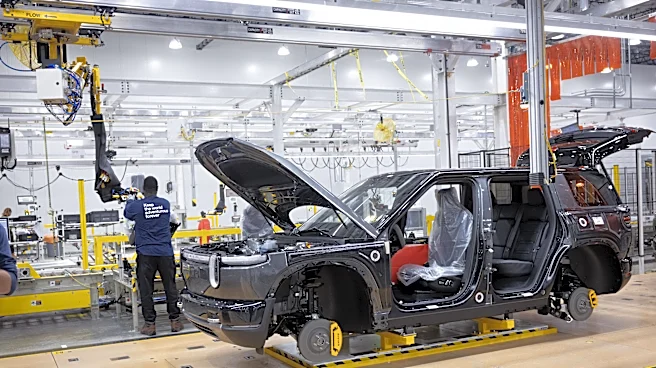
Rivian Automotive, a manufacturer of electric pickups, SUVs, and delivery vans, is heavily focused on scaling its production capacity. The company's strategy involves ramping up to a second shift at its Illinois plant and targeting approximately 4,000
R2 units per week, alongside plans for a 300,000-unit facility in Georgia. This expansion aims to increase installed production capacity, which is crucial for spreading fixed costs over more vehicles and potentially improving gross margins and earnings as volumes grow. Rivian generates most of its yearly revenue, about US$4.4 billion, from automotive sales, with an additional US$2 billion from software and services. The company's stock is currently valued near US$19.4 billion. The integration of software and services with its expanding manufacturing footprint is seen as a decisive factor for future margins and overall success.
Why It's Important?
Rivian's aggressive push to scale production and integrate software and services is critical for its long-term viability and competitiveness in the electric vehicle market. Increased production capacity is essential for meeting demand, achieving economies of scale, and ultimately moving towards profitability. For a company that is still burning cash to grow, efficient production scaling can significantly impact its financial health and ability to attract further investment. The emphasis on software and services revenue, which currently accounts for a substantial portion of its income, indicates a strategic shift towards higher-margin offerings that can provide recurring revenue streams and enhance customer loyalty. This dual focus on hardware manufacturing and software integration is a common strategy among modern EV companies aiming to differentiate themselves and capture greater value.
What's Next?
The success of Rivian's production ramp-up, particularly the planned second shift at the Illinois plant and the development of the Georgia facility, will be a key determinant of its future performance. Investors and analysts will closely monitor production numbers, delivery figures, and the impact of increased volume on the company's financial margins. The evolution of Rivian's software and services offerings, and their ability to generate sustainable revenue, will also be crucial. As the company continues to expand, it will face challenges related to supply chain management, manufacturing efficiency, and market competition. The interplay between its factory expansion and software development will define whether Rivian can accelerate its growth, encounter setbacks, or deviate from market expectations.
Beyond the Headlines
Rivian's strategy reflects a broader industry trend where automotive companies are transforming into technology and service providers. The 'collision of factories and code' highlights the convergence of traditional manufacturing with advanced digital capabilities. This shift has profound implications for the automotive industry, moving beyond just selling vehicles to offering integrated ecosystems of hardware, software, and services. For Rivian, this means not only producing electric vehicles but also developing a robust software platform that can generate recurring revenue and enhance the user experience. This approach could redefine how value is created and captured in the automotive sector, emphasizing the importance of continuous innovation in both product development and digital services. The success of this model could set a precedent for other EV manufacturers and influence consumer expectations for future vehicles.