








What's Happening?
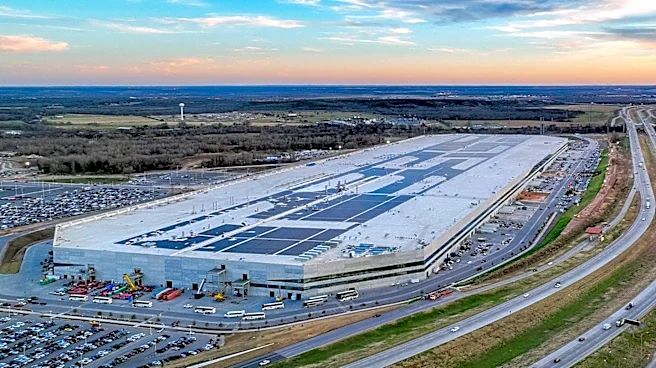
Covenant Industries, a defense technology startup, has emerged from stealth mode to announce the opening of a new 105,000-square-foot missile production facility in Grand Prairie, Texas. The company also unveiled its new long-range weapon system, Anthem,
designed for mass production. Covenant has secured over $250 million in funding across three rounds and approximately $150 million in pre-booked orders. Congressman Jake Ellzey, representing Texas’s sixth district, expressed strong support for Covenant Industries, highlighting North Texas's skilled workforce, engineers, and innovators as key factors in the company's decision to establish its factory there. Ellzey emphasized Covenant's understanding of its mission and its potential contribution to the defense community. The company, headquartered in Washington, D.C., also has production facilities in Saxony, Germany, and northern Israel. Serial production at the Texas plant is slated to begin in the first quarter of 2027, with a target of producing up to 5,000 units annually.
Why It's Important?
The establishment of Covenant Industries' missile factory in Grand Prairie, Texas, signifies a strategic move to address the U.S. military's depleted weapons stockpiles and the increasing demand for cost-effective, mass-produced defense systems. This initiative aligns with the Pentagon's updated weapons acquisition strategy, which aims to encourage new companies to enter the defense market. The focus on quantity over solely advanced technology, as articulated by Covenant's co-founder Michael Kaufman, suggests a shift in defense manufacturing priorities to ensure sufficient deterrence in prolonged conflicts. The company's ability to attract significant venture capital funding, including from Andreessen Horowitz and Founders Fund, underscores investor confidence in this new approach to defense industrial base challenges. Furthermore, the creation of a new manufacturing facility in North Texas will bring jobs and economic activity to the region, reinforcing its status as a major defense sector hub alongside established players like Lockheed Martin and Northrop Grumman.
What's Next?
Covenant Industries is scheduled to begin serial production of its Anthem missiles at the Grand Prairie facility in the first quarter of 2027, with plans to ramp up to 5,000 units per year. The company anticipates securing additional contracts before the end of the year, building on existing agreements with the U.S. Army for an accelerated test and qualification program and with the U.S. Navy to adapt a maritime variant of Anthem. Covenant's president and chief growth officer, Abby Denburg, indicated that the company's next phase will focus on execution and delivering mission-critical capabilities to customers on time and at scale. The company has already conducted over 200 flight tests of Anthem, including multiple tests with the U.S. Army. Future developments will likely include further testing, securing more contracts, and potentially disclosing more specific performance figures for the Anthem system, which currently lacks public details on range, payload weight, speed, and unit price.
Beyond the Headlines
Covenant Industries' emergence and its emphasis on mass production of affordable, long-range weapon systems highlight a broader re-evaluation within the U.S. defense industrial base. The company's strategy, which prioritizes quantity and cost-effectiveness, reflects lessons learned from recent conflicts where the consumption rate of precision strike missiles has outpaced production capabilities. This approach, championed by figures like former U.S. Deputy Secretary of Defense Kathleen Hicks, aligns with initiatives like the Pentagon's Replicator program, which focuses on scaling the delivery of affordable capabilities. The involvement of prominent venture capital firms in funding a defense startup also signals a growing trend of private investment in national security, potentially accelerating innovation and production in a sector traditionally dominated by established contractors. The company's international footprint, with factories in Germany and Israel, also suggests a move towards integrated allied supply chains, enhancing global defense capabilities and interoperability.