







What's Happening?
The United States has imposed 50% tariffs on $20 billion worth of Canadian products, effective early Saturday, following the breakdown of last-ditch negotiations. This move by President Trump's administration utilizes Section 338 of the Tariff Act of 1930,
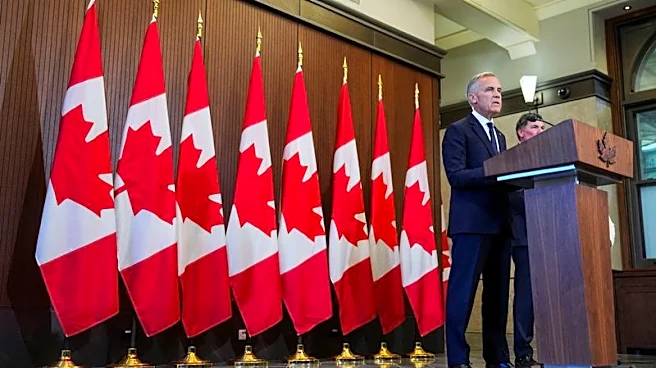
a Depression-era law that has never before been used to impose tariffs. The tariffs will affect approximately 5% of Canadian exports to the U.S., including items ranging from hockey sticks to tongue depressors. Canada has immediately announced it will retaliate with matching tariffs, escalating the trade conflict between the two historically cooperative nations. The U.S. Trade Representative Jamieson Greer stated that Canada declined to finalize a trade deal under previously agreed terms, citing new demands and walk-backs from Canada. Canadian Prime Minister Mark Carney, however, blamed the U.S. administration for the breakdown, citing 'last-minute changes' to proposed terms as unfair and uneconomic.
Why It's Important?
This imposition of tariffs marks a significant departure from the traditionally cooperative relationship between the U.S. and Canada, potentially jeopardizing the future of the North American trade agreement (USMCA). The use of the 1930 Tariff Act, known for its role in exacerbating the Great Depression by limiting world commerce, signals a more aggressive and unilateral U.S. trade policy. The economic fallout could be substantial, impacting industries in both countries. Canadian businesses and workers will face increased costs and reduced market access in the U.S., while American importers and consumers may experience higher prices. The move also raises questions about the stability of international trade relations and the potential for a broader trade war, especially given President Trump's previous imposition of double-digit import taxes on other countries and the Supreme Court's ruling against some of his earlier tariff justifications.
What's Next?
Canada has pledged to match the U.S. tariffs 'dollar for dollar' and Prime Minister Mark Carney has directed his negotiating team to return to Ottawa, with no further talks currently planned. The Canadian government is expected to announce additional support for Canadian workers and businesses in the coming days to mitigate the impact of the tariffs. The escalation of this trade conflict casts doubt on the renewal of the USMCA, as formal talks with Canada have not yet begun. Both sides are now publicly committed to their positions, making an 'off-ramp' from the conflict potentially harder to find. The political impact is expected to be even greater than the economic fallout, with public frustration growing in both countries. The situation could also influence upcoming midterm elections in the U.S., as voters are already concerned about the high cost of living.
Beyond the Headlines
The invocation of the 1930 Tariff Act, specifically Section 338, highlights a strategic shift in U.S. trade policy, moving towards tools that grant the President broad authority to impose tariffs without extensive investigation or time limits. This approach could set a precedent for future trade disputes, potentially leading to increased protectionism and instability in global trade. The historical context of the Smoot-Hawley tariffs, which are widely criticized by economists for worsening the Great Depression, adds a layer of concern regarding the long-term economic consequences. Furthermore, the deteriorating relationship with Canada, a long-standing ally, could have broader geopolitical implications, affecting cooperation on other fronts beyond trade. The public's reaction, including a petition to expel the U.S. Ambassador to Canada, underscores the deep frustration and the potential for lasting damage to bilateral relations.