




What's Happening?
The Dow Jones Industrial Average concluded the week ending November 20, 2026, with five consecutive trading days each seeing a decline of at least 1%. This marks the first time such a streak has occurred since October 10, 2008, according to Yahoo Finance.
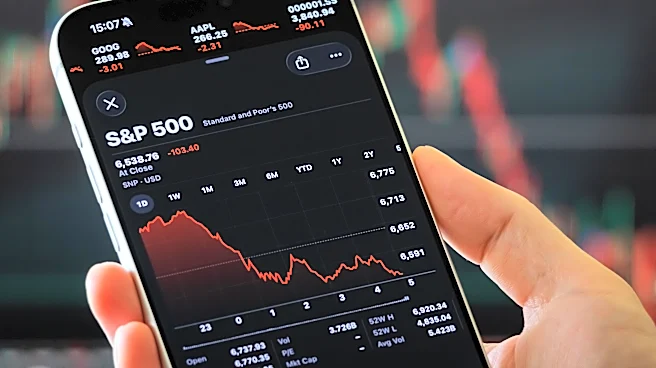
The index closed on Friday at 48,147.33, representing a drop of 949.73 points or 1.93%. Over the entire week, the Dow lost 8.02%, making it the worst weekly performance since March 20, 2020. The selling pressure intensified towards the end of the week, with Thursday and Friday experiencing the steepest drops of 2.19% and 1.93%, respectively. The Dow is now 11.4% below its record close of 54,349.12, achieved on August 5, 2026, placing it in 'correction territory' (a drop of 10% or more from a peak). The State Street SPDR Dow Jones Industrial Average ETF Trust (DIA) directly mirrored these losses, impacting its holders.
Why It's Important?
This significant downturn in the Dow Jones Industrial Average, characterized by five consecutive 1% daily declines, signals a period of heightened market volatility and investor concern within the U.S. financial landscape. The comparison to October 2008, a period of severe financial crisis, underscores the gravity of the current market sentiment, even if the underlying causes differ. While the 2008 downturn was driven by failing banks, the current situation is attributed to a repricing of AI expectations. This market correction impacts a broad spectrum of U.S. investors, particularly those holding index funds like DIA, which directly track the Dow. A sustained period of decline can erode retirement savings, reduce consumer confidence, and potentially lead to broader economic slowdowns if businesses face increased difficulty in accessing capital or if investment plans are curtailed. The entry into 'correction territory' suggests that investors are re-evaluating asset valuations, potentially leading to a more cautious investment environment.
What's Next?
The immediate focus for investors and market analysts will be to monitor whether the selling pressure continues or if a rebound materializes. Historically, sharp bounces after such streaks do not necessarily indicate the end of selling, as evidenced by the 2008 experience. The market will be closely watching for any catalysts that could either exacerbate the decline or trigger a recovery. This includes upcoming economic data releases, corporate earnings reports, and any shifts in sentiment regarding artificial intelligence investments. The performance of key price-weighted stocks within the Dow, such as Goldman Sachs and Caterpillar, which were noted as significant contributors to the recent decline, will be particularly scrutinized. Investors will also be assessing whether the market enters a 'bear market,' defined as a 20% drop from a peak, which would signal a more prolonged and severe downturn.
Beyond the Headlines
The current market behavior, particularly the comparison to 2008, highlights the psychological impact of historical market events on investor sentiment. Even with different underlying causes—AI expectations versus banking failures—the pattern of sustained declines can trigger similar anxieties and herd behavior among investors. This situation also underscores the inherent risks associated with concentrated sector investments, as the repricing of AI expectations has had a ripple effect across the broader market. Furthermore, the direct impact on holders of ETFs like DIA illustrates how passive investment strategies, while offering diversification, are still vulnerable to significant market-wide corrections. This event could prompt a re-evaluation of risk management strategies for both institutional and individual investors, emphasizing the importance of understanding market cycles and the potential for rapid shifts in valuation, even in seemingly robust sectors.