
What's Happening?
The Federal Communications Commission (FCC) has granted SpaceX conditional authorization to deploy up to one million satellites designed to function as data centers in space. This constellation, named
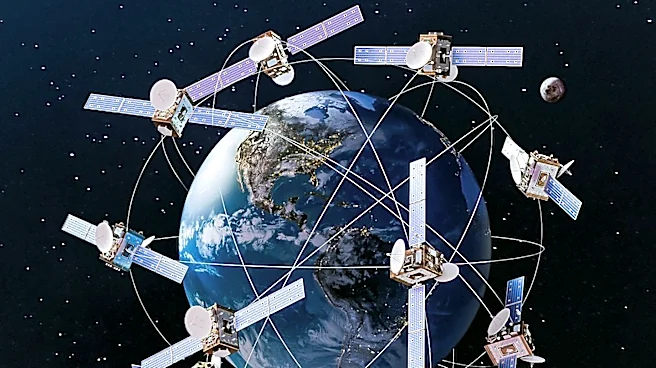
Starmind, will operate at altitudes between 500 and 1,002 kilometers above Earth. SpaceX has been given until November 2040 to complete the deployment of these satellites. Each Starmind AI1 satellite is specified to have a wingspan of 75 meters, a deployed height of 30 meters, and an average computing payload of 175 kW, with peak capabilities of 250 kW. The industry is currently divided on the feasibility and economic viability of space-based AI infrastructure. Elon Musk, CEO of SpaceX, believes space could offer the cheapest AI computing within 30 to 36 months, while Jeff Bezos anticipates gigawatt-scale orbital data centers within 10 to 20 years. Conversely, AWS CEO Matt Garman has expressed skepticism, questioning how the space industry could match the speed of terrestrial GPU installations, noting Amazon installs a GPU every 14 seconds.
Why It's Important?
This FCC authorization marks a significant step towards the potential establishment of a vast space-based computing infrastructure, which could profoundly impact the future of artificial intelligence and data processing. If fully deployed, even a fraction of the authorized satellites could represent an unprecedented scale of computing power. For instance, 10,000 Starmind satellites, representing just 1% of the authorized constellation, could provide 1.75 GW of IT power capacity and potentially one million AI accelerators. This capacity would surpass that of the largest operational AI data centers today, such as Amazon and Anthropic’s New Carlisle facility (1.037 GW). The development could shift the economics of AI computing, potentially making space a competitive environment for data processing. However, the success hinges on overcoming significant challenges related to launch capacity, the economics of operating infrastructure in orbit, and the ability to attract customers for this capacity. The debate among industry leaders like Musk, Bezos, and Garman highlights the uncertainty and differing visions for the future of AI infrastructure.
What's Next?
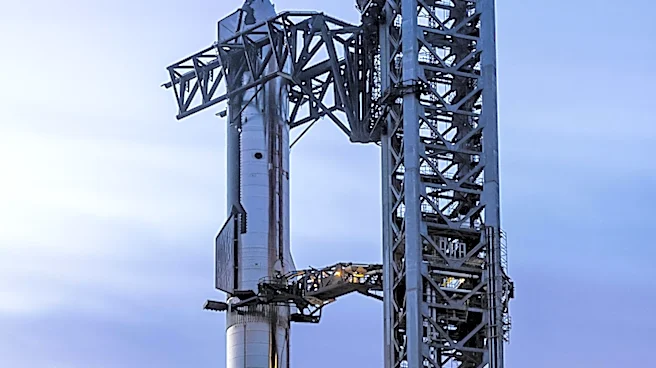
SpaceX faces the monumental task of manufacturing and launching up to one million satellites by November 2040, a timeline considered incredibly tight given the scale. The company will need to demonstrate the commercial viability of its Starmind constellation, including proving that the hardware delivers competitive performance and that there is sufficient market demand for space-based AI computing. The ongoing debate within the industry regarding the cost-effectiveness and operational challenges of orbital data centers will likely continue. Future developments will include monitoring SpaceX's progress in deployment, assessing the actual computing capacity and performance of the Starmind satellites, and observing how the economics of accessing and operating in space evolve. The success of Starmind could lead to a new era of space-based data centers, potentially attracting more investment and innovation in this nascent field.
Beyond the Headlines
The FCC's decision to authorize such a massive constellation of orbital data centers raises several deeper implications. Environmentally, the sheer number of satellites could exacerbate concerns about space debris and its impact on future space operations and astronomical observations. Economically, if successful, this venture could create a new sector within the space industry, driving innovation in satellite manufacturing, launch services, and in-orbit maintenance. It also challenges traditional notions of data center location and security, potentially offering new paradigms for data sovereignty and resilience. The energy consumption of such a constellation is also a significant consideration; at full deployment, Starmind's 175 GW could translate to approximately 1,533 TWh of annual electricity consumption, far exceeding current global data center consumption. This highlights the need for sustainable power solutions in space and on Earth to support such ambitious projects. The project also underscores the increasing convergence of space technology and advanced computing, pushing the boundaries of what is possible in both domains.