
What's Happening?
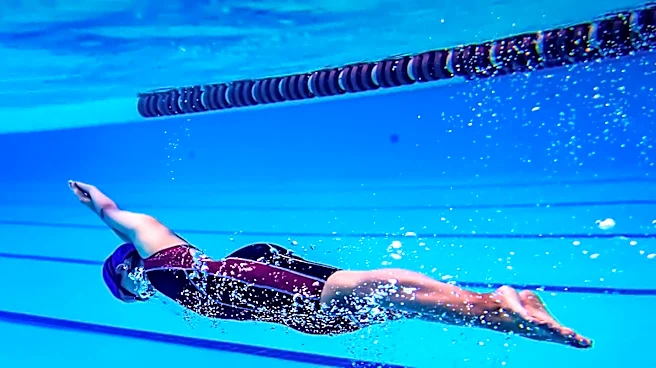
Mollie O'Callaghan, a 20-year-old Australian swimmer, has solidified her status as a global swimming star following her performance in the 200-meter freestyle at the Paris Olympics. During this event,
she achieved an Olympic record with a time of 1:53.27, surpassing her training partner and reigning Olympic champion, Ariarne Titmus, who finished second. The race was particularly notable for O'Callaghan's strong finish in the final 50 meters, where she accelerated to overtake Titmus. This victory marks a significant moment in her career, transitioning her from a key member of a legendary Australian team to an individual star. Her performance has been highlighted as a memorable moment in swimming, showcasing her ability to perform under pressure and execute a well-rehearsed strategy. The event also featured Siobhán Haughey of Hong Kong, who placed third.
Why It's Important?
O'Callaghan's rise to prominence is significant for the sport of swimming, particularly in Australia, which has a strong tradition in freestyle. Her victory, especially over a highly regarded competitor like Titmus, demonstrates the depth of talent within Australian swimming and signals a potential shift in the hierarchy of elite female freestylers. This internal competition can push athletes to achieve higher levels of performance, benefiting the national team in future international competitions. For the global swimming community, O'Callaghan's emergence adds another compelling narrative and rivalry, which can increase viewership and interest in the sport. Her ability to combine speed and endurance, as evidenced by her success in both 100-meter and 200-meter freestyle events, makes her a versatile and formidable opponent, posing a challenge to competitors worldwide.
What's Next?
Following her Olympic record-breaking performance, Mollie O'Callaghan is expected to be a central figure in upcoming international swimming events. Her versatility in both 100-meter and 200-meter freestyle events suggests she will be a key contender in multiple races, including individual events and relays, where Australia often excels. The dynamic between O'Callaghan and Titmus, as training partners and rivals, will likely continue to be a focal point, potentially leading to more exciting competitions. Her continued development and performance will be closely watched as she navigates the pressures of being a newly recognized global star. The Australian swimming trials, such as those returning to Sydney in 2027, will be crucial for her to secure spots in future World Aquatics Championships and other major competitions.
Beyond the Headlines
Beyond the immediate athletic achievement, O'Callaghan's story highlights the psychological and strategic dimensions of elite sports. Her ability to maintain composure and execute her race plan, even when trailing, speaks to a high level of mental fortitude. The narrative of overcoming a highly decorated training partner also adds a layer of human interest, showcasing the complex relationships within competitive sports where camaraderie and rivalry coexist. This event could inspire a new generation of swimmers, particularly in Australia, by demonstrating that consistent effort and strategic training can lead to breakthrough performances on the world stage. Her success also underscores the importance of robust national swimming programs that nurture talent from a young age, providing the foundation for athletes to achieve global recognition.