







What's Happening?
Galveston Wharves and Royal Caribbean Group are currently in negotiations to develop a fifth cruise terminal at Pier 14 in Galveston, Texas. This potential expansion signals Royal Caribbean's intent to increase its presence in the Gulf region, with the port
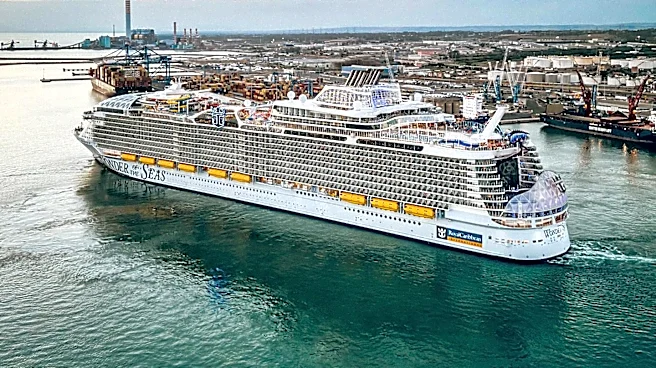
director explicitly mentioning the possibility of hosting an Icon-class ship, such as the Icon of the Seas. While no final agreement has been signed, and the port's board recently deferred a nonbinding memorandum of understanding for further negotiation, the discussions indicate a strong mutual interest. The proposed terminal would be designed to accommodate the largest ships in Royal Caribbean's fleet, which can carry up to 7,600 guests at maximum occupancy. This project follows a successful public-private partnership between Royal Caribbean and Galveston Wharves that resulted in the $125 million Pier 10 terminal complex, opened in 2022. The current negotiations are focused on financing, construction, and operational aspects, with the full agreement requiring board approval at a later date.
Why It's Important?
This potential fifth cruise terminal in Galveston is significant for the U.S. cruise industry and the Gulf Coast economy. Galveston has emerged as a crucial cruise port, and Royal Caribbean's investment in a new terminal capable of handling Icon-class ships would solidify its position in this market. For consumers in Texas, Louisiana, and Oklahoma, it would provide access to Royal Caribbean's newest and largest vessels without the need for air travel to Florida, potentially saving families substantial travel costs. Economically, the port projects that a fifth terminal would create an additional 1,500 jobs, generate $278 million in business revenue, $91.5 million in personal income, and $7.9 million in state and local taxes. This expansion would also intensify competition among cruise lines for berths in Galveston, as other operators like Margaritaville at Sea are also increasing their presence in the port, further boosting the region's economic activity and tourism sector.
What's Next?
The immediate next step involves further negotiations between Galveston Wharves and Royal Caribbean Group to finalize the terms of the agreement, including financing, construction, and operations. The port's board of trustees will need to approve the full agreement once negotiations are complete. While no specific timeline or opening date has been announced, terminal projects of this scale typically take several years from agreement to completion. For cruisers, existing bookings for 2026 and 2027 from Galveston will remain unaffected. Longer-term, if the terminal is built, passengers can anticipate the deployment of larger, newer ships to Galveston, which could lead to a shift in pricing dynamics, with newer ships commanding higher fares and older vessels potentially becoming more affordable. Additionally, increased capacity will likely lead to more traffic on Harborside Drive and greater competition for parking on busy turnaround days, necessitating advanced planning for port logistics.
Beyond the Headlines
The discussions surrounding a fifth cruise terminal in Galveston highlight a broader trend in the cruise industry: the strategic importance of homeports and the increasing size of cruise ships. By investing in dedicated terminals, cruise lines like Royal Caribbean gain greater control over their operations and enhance the passenger experience, from embarkation to disembarkation. The mention of Icon-class ships, which are essentially floating cities, underscores the industry's move towards larger, more amenity-rich vessels designed to be destinations in themselves. This trend has implications for port infrastructure development, requiring significant investments in dredging, pier length, gangway capacity, and land-side transportation networks. Furthermore, the public-private partnership model used for the Pier 10 terminal and proposed for Pier 14 demonstrates how local governments and private corporations are collaborating to fund large-scale infrastructure projects that benefit both the cruise lines and the regional economy, setting a precedent for future port expansions across the U.S.