







What's Happening?
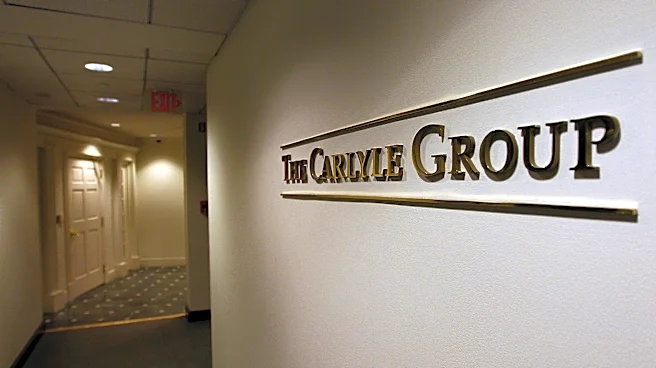
The Carlyle Group (NASDAQ: CG), a global investment firm, recently announced record third-quarter fee-related earnings and assets under management totaling US$479 billion. Despite these strong financial results and a declared quarterly dividend of US$0.35,
the company's stock experienced a 6.53% decline in a single day. Over the past 90 days, the stock has fallen by 16.38%, and it is down 34.34% year-to-date. This downturn comes as investors weigh short-term earnings revisions against the broader, longer-term private markets narrative. The firm's stock closed at $39.96, which is below a narrative fair value of $52.50, suggesting a potential undervaluation according to some analyses. However, other perspectives indicate the stock might be overvalued based on its P/E ratio of 39.1x, compared to an industry average of 36.7x and a peer average of 30.6x.
Why It's Important?
The mixed market reaction to The Carlyle Group's record earnings highlights the complex sentiment surrounding private equity firms in the current economic climate. While strong fee-related earnings and substantial assets under management typically signal robust performance, the simultaneous decline in stock price suggests investor caution. This divergence could be attributed to broader macroeconomic uncertainties and geopolitical factors, which have led to a slower-than-anticipated private equity activity, particularly in direct lending volumes. The firm's strategic shift towards higher-quality credit profiles and a measured approach to sectors like AI compute and data centers, despite their prominence, indicates a focus on risk mitigation. This cautious stance, while potentially safeguarding against future volatility, might also be perceived by some investors as a slower growth trajectory compared to more aggressive market players, influencing short-term stock performance.
What's Next?
The Carlyle Group faces a critical juncture where it must balance its strong operational performance with investor sentiment. The firm's ability to maintain or accelerate the momentum of its AlpInvest segment will be crucial for future growth and investor confidence. Continued dividend payouts and share repurchases, especially if executed below intrinsic value, could help enhance shareholder value. However, the narrative of undervaluation could be challenged if AlpInvest's growth slows or if weaker buyout fund performance impacts fundraising and fee profitability. Investors will closely monitor the firm's credit performance, particularly the non-accrual rates, and its ability to navigate market uncertainties while maintaining broad industry diversification. The ongoing debate between the stock's perceived undervaluation and its high P/E ratio suggests that future earnings reports and strategic announcements will be key in shaping its market trajectory.
Beyond the Headlines
The situation at The Carlyle Group reflects a broader trend in the financial markets where strong fundamental performance does not always translate into immediate stock appreciation, especially for alternative asset managers. This disconnect underscores the influence of market narratives, investor psychology, and macroeconomic headwinds on stock valuations. The firm's cautious approach to emerging sectors like AI, while prudent from a risk management perspective, also highlights the challenge of balancing innovation with stability in a rapidly evolving investment landscape. The emphasis on '1 Carlyle' platform generating new originations outside direct lending channels suggests a strategic diversification of revenue streams, which could be a long-term resilience factor. This scenario also brings to light the differing valuation methodologies—narrative fair value versus P/E ratios—and how they can lead to conflicting assessments of a company's true worth, creating opportunities and risks for different types of investors.