




What's Happening?
Retailers are fundamentally rethinking their supply chain strategies, moving away from a sole focus on efficiency and predictability towards greater adaptability and resilience. This shift is a direct response to the normalization of supply chain disruptions,
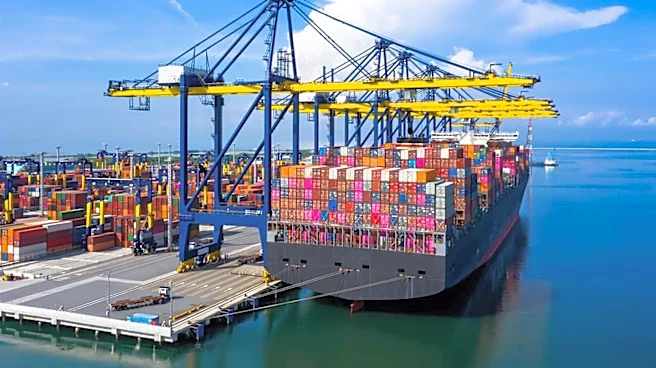
which now include shifting trade policies, geopolitical tensions, port congestion, and labor shortages. A new report by DP World and Supply Chain Dive, based on a survey of 100 retail supply chain leaders, reveals that 95% consider disruption to be extremely or very important to their organizations, and 57% experienced transportation bottlenecks or port congestion in 2025. Despite these challenges, 80% of retailers express high confidence in their ability to withstand major disruptions over the next three years, indicating a proactive evolution in their approach. Traditional strategies, which prioritized predictable routes and just-in-time inventory, are proving unsustainable in the current volatile environment.
Why It's Important?
This strategic pivot by retailers has significant implications for the U.S. economy and consumer markets. The move towards adaptability means that businesses are actively adjusting supply chain routing to address tariff impacts (74% of leaders) and optimizing routes to manage costs (53%). This indicates that transportation routing is no longer just an operational detail but a critical strategic capability. Retailers capable of evaluating alternative routes, transportation modes, and logistics partners are better positioned to maintain product availability, which directly impacts consumer access to goods and price stability. The emphasis on resilience over pure efficiency suggests a willingness to absorb potentially higher costs in exchange for greater stability and reduced risk of stockouts. This could lead to more diversified sourcing, increased investment in logistics infrastructure, and stronger partnerships with a wider array of suppliers and carriers, ultimately benefiting consumers through more consistent product availability.
What's Next?
The trend towards dynamic and adaptable supply chains is expected to continue, with retailers further investing in capabilities that allow them to respond swiftly to unforeseen events. This includes developing more sophisticated data analytics for real-time visibility into their supply networks, exploring nearshoring or reshoring options for critical components, and building stronger, more flexible relationships with logistics providers. The focus will be on creating redundant systems and alternative pathways to ensure continuity of supply, even if it means moving away from the lowest-cost options. This could also spur innovation in logistics technology, such as advanced tracking systems and AI-driven route optimization. The long-term outcome is likely to be more robust, albeit potentially more complex and costly, supply chains that are better equipped to handle the persistent disruptions characteristic of the modern global economy.
Beyond the Headlines
The shift from efficiency to adaptability in retail supply chains reflects a broader re-evaluation of global economic interconnectedness. For decades, globalization prioritized cost reduction through highly optimized, lean supply chains. However, the recent series of global events—from the pandemic to geopolitical conflicts—has exposed the inherent fragility of such systems. This change signifies a move towards a more risk-aware and resilient economic model, where the trade-off between cost and security is being rebalanced. It also highlights the increasing importance of strategic foresight and scenario planning for businesses. The ability to anticipate and prepare for a wider range of disruptions, rather than simply reacting to them, will become a key competitive advantage. This paradigm shift could also influence public policy, potentially leading to government incentives for supply chain diversification and domestic production capabilities, further intertwining business strategy with national economic security.