





What's Happening?
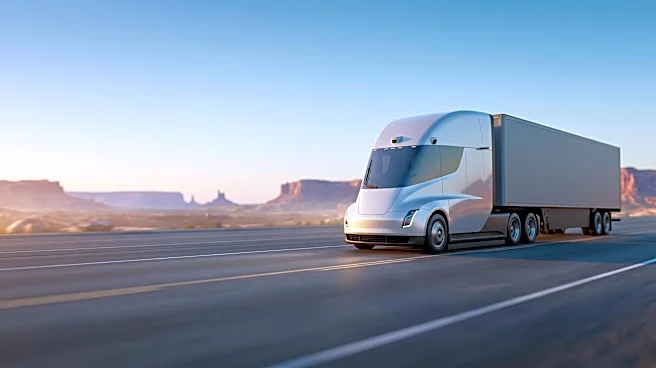
Aurora Innovation (Nasdaq: AUR) announced plans to operate over 30,000 driverless trucks by 2030, aiming for more than $5 billion in revenue and a 60% gross margin by that year. This ambitious target was shared with analysts and investors at their Analyst
and Investor Day in Dallas on September 23. The company is transitioning from a 'Transport as a Service' (TaaS) model, where Aurora owns and operates the trucks, to a 'Driver as a Service' (DaaS) model. Under DaaS, carriers will own and operate the trucks, paying Aurora for the autonomous driving technology. Aurora expects to cap its TaaS fleet at approximately 500 trucks, with the majority of future growth coming from the DaaS model. The company has logged over 500,000 driverless miles since its commercial launch.
Why It's Important?
Aurora's strategic shift to a Driver-as-a-Service model and its aggressive target of 30,000 driverless trucks by 2030 represent a significant development for the U.S. trucking and logistics industry. This move could revolutionize freight transportation by addressing the persistent driver shortage, improving operational efficiency, and potentially reducing costs for carriers. Driverless trucks can operate for longer hours, leading to higher asset utilization (projected to more than double that of traditional trucks) and faster delivery times. While the initial cost of insurance for autonomous trucks is currently slightly higher due to the 'unknowns,' experts anticipate rates will fall as more data becomes available. This transition could lead to substantial savings for carriers, with Aurora's analysis suggesting savings of over 20% or 50 cents per mile compared to solo-driven trucks, ultimately impacting supply chains and consumer prices.
What's Next?
Aurora is currently fully allocated to have 200 driverless trucks in operation by the end of 2026, generating an estimated $80 million in revenue. The company expects to reach breakeven gross margin on a run-rate basis in the first half of 2027 with about 500 trucks. Production of its second-generation hardware kit by Fabrinet and Roush is ramping up, with Roush targeting 20 trucks per week by October. The third-generation kit, developed with AUMOVIO, will introduce a hardware-as-a-service structure, with production starting in the second half of 2027 and significant economic benefits expected from 2028 onwards. Carriers like Hirschbach intend to own and operate 500 trucks under a DaaS agreement starting in 2027. The industry will closely watch how quickly carriers adopt the DaaS model and how insurance costs evolve as more data on autonomous vehicle safety becomes available.
Beyond the Headlines
The planned expansion of driverless trucks by Aurora has profound implications beyond just logistics. It signals a major step towards the widespread adoption of autonomous technology in critical industries, potentially reshaping the future of work for truck drivers and creating new job categories in remote operations and maintenance. The shift to a DaaS model also highlights a broader trend in technology, where complex hardware and software solutions are increasingly offered as services, reducing upfront capital expenditure for customers and enabling faster adoption. Ethical and regulatory considerations, such as liability in accidents and the impact on the human workforce, will continue to be central to the public discourse. Furthermore, the success of this initiative could pave the way for autonomous technology in other sectors, driving innovation and efficiency across the economy while necessitating careful societal adjustments.